
The New Zealand dollar remained range-bound against the greenback yesterday following the release of slightly better-than-expected economic data from both the US and New Zealand. While New Zealand’s economy grew by 0.90% q-o-q in the second quarter, US unemployment claims unexpectedly declined last week. Overall, the NZD/USD pair traded in a narrow range of between 0.5895 and 0.5933 in the past 24 hours.
According to Statistics New Zealand, the country’s economy grew by 0.90% q-o-q in the June 2023 quarter after remaining flat in the previous quarter, more than double the forecasts for 0.40% GDP growth. Additionally, GDP per capita inched up 0.20% in the June 2023 quarter.
On a year-over-year basis, the New Zealand economy expanded 3.20% in June 2023.
The country’s GDP expenditure increased by 1.30% in 2Q 2023, following a 0.20% decline in the March 2023 quarter.
Business services rose by 2.10%. Specifically, public administration, safety, and defense grew by 2.80%. Rental, hiring, and real estate services inched up 0.70%. Likewise, electricity, gas, water, and waste services grew by 0.90%. Agriculture, forestry, and fishing declined by 2.30%. Also, retail trade, accommodation, and restaurants inched down 1.0%.
Goods-producing industries rose by 0.70%. In particular, exports of goods and services grew by 5% while imports of goods and services were down by 2%.
The statistical organization also stated that real gross national disposable income rose by 0.80% in 2Q23. Also, real gross national disposable income per capita inched up 0.10%.
According to the data published by the US Department of Labor, the country’s unemployment claims declined to 201,000 in the week ended September 16 from 221,000 in the previous week and bettered forecasts of 224,000 claims.
The four-week moving average was 217,000, down from 224,750 in the previous week.
The Philly Fed manufacturing index, reflecting general economic activity, declined to -13.50 in September from 12 in August, worse than forecasts of -1.10. The reported figure reflects the 14th negative reading in the last 16 months.
The new orders index declined to -10.20 in September from 16 in August. Likewise, the shipments index fell to -3.20 from 9. The employment index remained almost unchanged at -5.70.
Notably, the future general activity index increased to 11.10 in September from 3.90 in August.
According to the data published by the US Bureau of Economic Analysis, the country’s current account deficit narrowed to $212 billion in the June 2023 quarter from $214.50 billion in the previous quarter. Economists had anticipated a widening of the current account deficit to $220 billion.
Exports of goods and services fell by $7.80 billion to $1.15 trillion in 2Q 2023. Similarly, imports of goods and services declined from $10.20 billion to $1.36 trillion.
Specifically, exports of goods decreased from $29 billion to $497.60 billion in September. Imports of goods fell by $17.10 billion to $772.80 billion. Additionally, exports of services rose by $4.70 billion to $247.30 billion. Imports of services fell by $5.50 billion to $175.70 billion.
The slightly better-than-expected economic data from both countries is expected to keep the NZD/USD pair range-bound in the short term.
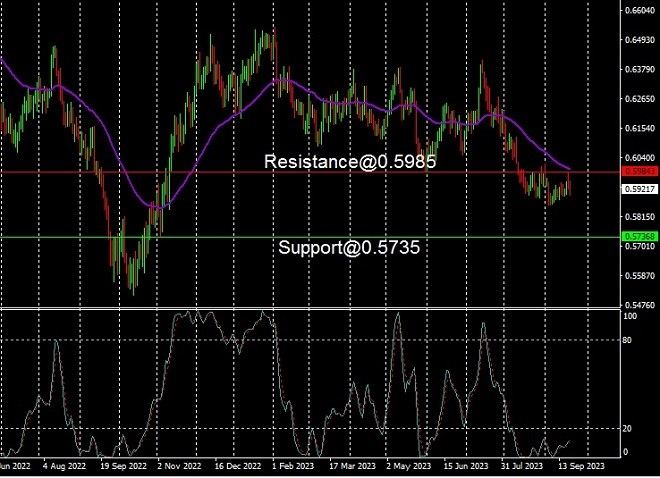
The historical price chart indicates that the NZD/USD pair has broken the support at 0.5985. The next support is anticipated to be only near 0.5735. Additionally, the currency pair is trading below its 50-day moving average, while the stochastic indicator is in the bearish zone. Therefore, we anticipate the NZD/USD pair to remain in a downtrend in the near term.
Disclaimer: Any financial trading analysis offered here is our opinion and is not intended as advice or direction for investors. We cannot guarantee the success of any trades made as a consequence of this article, and we encourage traders to incorporate a strong money management strategy to limit losses when they enter the markets. Please use this article as part of your own research before formulating strategies prior to trading.