
The Kiwi dollar continues its unabated downtrend against the currencies of developed countries for two main reasons: weakness in the commodity market and an interest rate hike in other developed economies. The New Zealand governor Adrian Orr stated earlier today that ‘short-term’ thinking is a primary challenge for the economy and society. The governor also indicated that there is a need to maintain low and unwavering consumer price inflation, which would ultimately lead to a robust and effective financial system.
On the economic front, however, things are not moving as wanted. The dairy product prices continue to decline, putting the future of dairy farming at risk. At the previous twelve dairy auctions that took place between March the 20th and September the 4th, the dairy prices increased marginally to only 4. The average dairy product prices have fallen to $2,980 per ton in the most recent auction, and the dairy product prices had declined by 6.5% on the m-o-m basis in July.
ANZ’s chief economist Sharon Zollner pointed out that “overall dairy prices are down 7.9% year on year, with butter down 21.1%, cheese down 7.4% and whole milk powder down 5.5%.”
New Zealand is also entirely dependent on crude import, and the rise in the price of crude is likewise affecting the growth prospects of the country. In NYMEX, the crude (October contract) closed at $67.85 per barrel yesterday. When uncertainty prevails, the global commodity currencies are the first to get beaten. The NAFTA uncertainty related to the Canada, Brexit issue, and the looming US-China trade war are keeping the Kiwi dollar bearish.
The Swiss Franc, on the contrary, strengthens during times of uncertainty as it is considered as a safe haven by a majority of investors. The sanctions imposed on Turkey and the officially announced recession in South Africa have forced investors to look for a secure cover, and as a result, investors are avoiding the emerging market currencies.
On the economic front, Swiss inflation data reported on Tuesday was in line with economists’ expectations. Swiss consumer prices rose 1.2% y-o-y in August, the same pace at which it rose in the preceding month. On a monthly basis, consumer prices remained unchanged after declining 0.2% in July. The Swiss National Bank (SNB) has forecast 0.9% inflation for both 2018 and 2019.
Switzerland’s GDP rose by 0.7% q-o-q in 2Q18, an above-average, and robust growth rate. Moreover, 1Q18 growth figures were upwardly revised to 1% q-o-q, from the prior estimate of 0.6%. Annual GDP growth was 3.2% year-on-year in the first and second quarter of 2018. Notably, for the fifth quarter in a row, the Swiss economy has recorded an above-average growth rate. All these factors keep the Swiss Franc bullish.

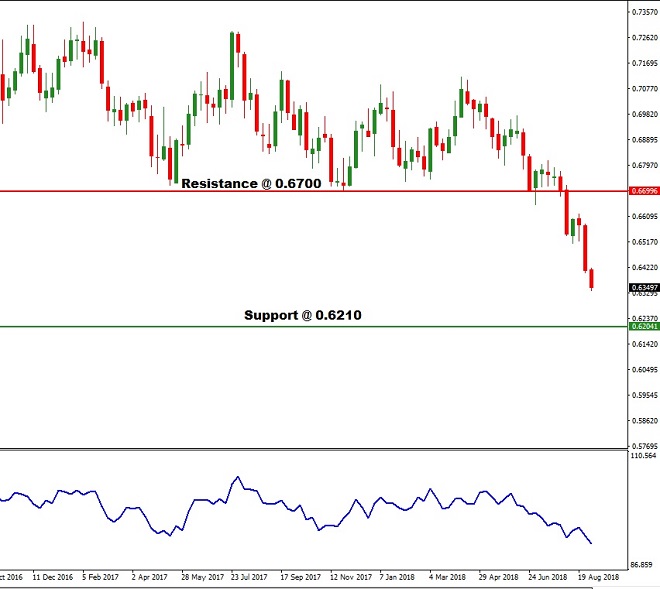
Technically, the NZDCHF pair has broken the support at 0.6700. The next significant support is at 0.6210. Furthermore, the momentum is declining, and a currency trader can, therefore, anticipate the NZDCHF pair to remain in a downtrend.
Disclaimer: Any financial trading analysis offered here is our opinion and is not intended as advice or direction for investors. We cannot guarantee the success of any trades made as a consequence of this article, and we encourage traders to incorporate a strong money management strategy to limit losses when they enter the markets. Please use this article as part of your own research before formulating strategies prior to trading.