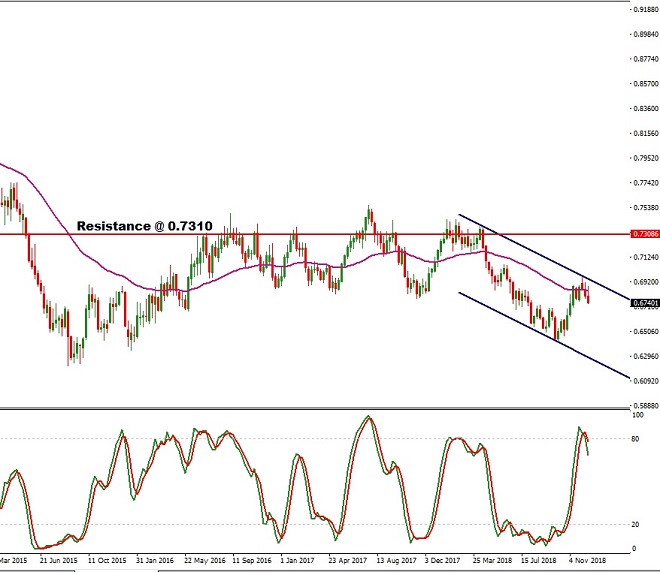
The New Zealand dollar plunged after the US Federal Reserve raised its benchmark interest rates yesterday. Mixed economic data also amplified the Kiwi dollar’s losses against the greenback. The NZDUSD pair has fallen to 0.6700, from 0.6840 in the past 24 hours. The prevailing conditions, as discussed below, support a continuation of the downtrend.
Weak GDP growth and Fed rate hike pushes Kiwi dollar lower
The most significant downbeat factor for kiwi (outside of the Fed announcement) was the below-par growth of New Zealand’s gross domestic product (GDP). Statistics New Zealand stated that GDP grew 0.3% in the September quarter of 2018. The rate of increase was twice as slow as the 0.6% anticipated by economists. Furthermore, the GDP growth rate was also slower than 1.0% registered in the previous quarter.
Primary industries recorded a growth of 2.2% in 3Q18, while goods-producing industries contracted by 1.0%. Service industries grew by 0.5%. However, per capita GDP remained flat, and real national gross disposable income increased by 0.9%. Interestingly, business investment declined by 2.1%, with investment in plants, machinery, and equipment contributing to the decline. Mining expanded 12% in the September 2018 quarter, as it began to bounce back from a considerable drop in the June 2018 quarter. Presently, the size of the Kiwi economy, based on the current prices, is NZ$291 billion.
Foreign companies that repatriate money from their own subsidiaries in New Zealand have caused the country to record its largest annual current account deficit for a decade.
On a quarterly basis, the unadjusted current account deficit widened to NZ$6.15 billion in the September quarter, from NZ$1.63 billion in the earlier quarter. It was a higher figure than the NZ$5.94 billion forecast by specialists.
For the year ending September 30, 2018, the annual deficit widened to $10.5 billion, or 3.6% of gross domestic product. In the year-ago period, the yearly deficit stood at $7.4 billion, or 3.3% of the GDP, Statistics New Zealand said.
On a positive note, the trade deficit shrank to NZ$861 million in November, from NZ$1.317 billion in October. Economists had anticipated the trade deficit to decline to NZ$880 million. While the poor GDP data weakened the New Zealand dollar, the rate hike announced by the Fed strengthened the greenback.
As markets had anticipated, the Fed announced a 24 basis points hike to its benchmark rate. With that announcement, the target range for its benchmark funds rate is 2.25% to 2.5%. The announcement marked the fourth hike this year and the ninth from the time the Fed started normalizing rates in December 2015.
The rate hike was announced despite strong opposition via tweets by US President Donald Trump. Following the announcement, Trump said “it is incredible” that “the Fed is even considering yet another interest rate hike.”
More importantly, officials now forecast two hikes in 2019, which is a downwardly revised forecast but still higher than the current market’s expectation of no additional hikes in 2019. It should be noted that the post-meeting statement issued by the Fed was not entirely dovish.
The Fed’s statement says: “The Committee judges that some further gradual increases in the target range for the federal funds rate will be consistent with sustained expansion of economic activity, strong labor market conditions and inflation near the Committee’s symmetric 2 percent objective over the medium term.”
The Fed’s rate hike and the statement forecasting two more rate hikes next year has turned the greenback bullish. As a result, we can expect the Kiwi dollar to fundamentally remain weak against the US dollar in the short term.
Technically, the NZDUSD pair is trading below its 50-day moving average. The currency pair is also moving along the descending channel. Additionally, the stochastic indicator has started declining after reaching the overbought region. Therefore, we are expecting the downtrend to continue in the near-term future.
Disclaimer: Any financial trading analysis offered here is our opinion and is not intended as advice or direction for investors. We cannot guarantee the success of any trades made as a consequence of this article, and we encourage traders to incorporate a strong money management strategy to limit losses when they enter the markets. Please use this article as part of your own research before formulating strategies prior to trading.