
The pound traded within a narrow range against the yen yesterday, influenced by weak economic data from both Japan and the UK. While Japan’s trade deficit widened more than anticipated, the UK’s public sector net borrowing in July was higher than anticipated. There were no other major economic releases. Overall, the GBP/JPY pair traded in a range of 189.14 and 190.71 in the past 24 hours.
According to Japan’s Ministry of Finance, the country’s trade deficit widened to ¥621.84 billion in July 2024 from ¥61.33 billion in July 2023. Economists had anticipated a deficit of only ¥330.70 billion. The reported figure reflects the fifth deficit in 2024, as imports rose quicker than exports. It can be remembered that the Japanese yen hit a 38-year low in July 2024. On average, the yen traded at 159.77 against the greenback last month, reflecting a depreciation of 12.30% from July 2023.
Specifically, imports grew by 16.60% year-on-year, reflecting the highest level since January 2023, to a 19-month peak of ¥10,241,008 billion, surpassing expectations of 14.90%.
The exports surged to 10.30%, reflecting the eighth successive monthly increase, to a seven-month high of ¥9,619.17 billion, but lower than market forecasts of 11.40%. The increase was led by an increase in the exports of cars and semiconductor parts. On a volume basis, exports decreased by 5.20% y-o-y in July 2024. Notably, exports grew by 5.40% y-o-y in June.
In terms of geographic region, Japan’s exports to the US surged 7.30% y-o-y in July, a slight decline from June. The pace of growth in exports to China stood unaltered at 7.20%. However, shipments to the EU fell by 5.30%. Interestingly, Japan’s economy expanded in the June 2024 quarter at an annualized rate of 3.10%. This is the first growth in two quarters, fueled by a strong rebound in consumer spending. Overseas demand stood sluggish as imports eclipsed exports.
According to the data published by the UK Office for National Statistics, the country’s public sector net borrowing, excluding public sector banks, increased to £3.1 billion in July 2024 from £1.3 billion in July 2023. The market was expecting the UK public sector net borrowing to be under £1.5 billion.
The receipts grew by £2 billion to £99.4 billion, fueled by income tax. This was partly negated by lower National Insurance Contributions. The UK’s borrowing was £51.4 billion in the financial year that ended July 2024, down £0.5 billion from July 2023. Despite the decline, the figure represents the fourth-highest borrowing since the statistical organization started documenting data in January 1993.
Weak economic data from both countries is likely to keep the GBP/JPY pair within a limited range in the near term.
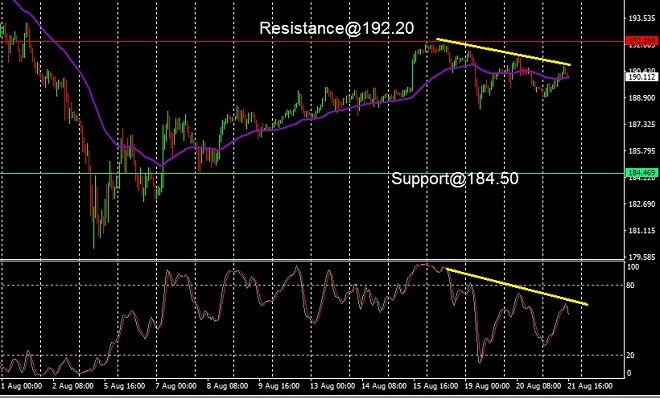
The historical price chart indicates that the GBP/JPY pair is descending after failing to break the resistance at 192.20. The next major support is anticipated to be only near 184.50. Additionally, the GBP/JPY pair is trading below its 50-day moving average, while the stochastic indicator is forming lower highs. This indicates a likelihood of further downtrends in the currency pair.
Disclaimer: Any financial trading analysis offered here is our opinion and is not intended as advice or direction for investors. We cannot guarantee the success of any trades made as a consequence of this article, and we encourage traders to incorporate a strong money management strategy to limit losses when they enter the markets. Please use this article as part of your own research before formulating strategies prior to trading.