The Japanese yen rallied against the Canadian dollar in the Asian session, resulting in the better-than-anticipated producer price index and upbeat preliminary machine tool orders data.
The gains increased in the US session following lower than anticipated housing starts data by the Canada Mortgage and Housing Corporation (CMHC). In the past day, the CAD/JPY pair weakened from a high of 90.35 to 90.01.
According to the Bank of Japan, the producer price index (PPI) increased 3.6% y-o-y in April, following a rise of 1.2% in the previous month and more significant than the 3.1% growth anticipated by economists.
The reported figure represents the increase in the producer price index for the second consecutive month, mirroring the reopening of economies worldwide and the rise in crude oil prices. Furthermore, it is the sharpest rise since September 2014.
The price of petroleum, coal, and chemical products increased with the rise in crude prices. The increase in PPI indicates that momentum builds up for a robust economic rebound as the COVID-19 vaccination plan moves forward.
Increasing automobile production also drove the price of steel, iron, and non-ferrous metals higher.
Officials at the Bank of Japan have pointed out that the price rise is primarily due to an increase in external demand. Still, the forecast for oil and other products remains uncertain because of the sudden surge in COVID-19 infections in India and other countries.
According to the data published by the Japan Machine Tool Builders Association (JMTBA), preliminary machine tool orders increased 120.8% y-o-y in April, following a growth of 65.1% in the earlier month.
In the US session, the CMHC stated that housing starts were 269,000 units in April, down from 335,000 units in the earlier month. Economists had anticipated housing starts of 305,000 units for the reported period.
Furthermore, based on a six-month moving average of monthly seasonally adjusted annual rates (SAAR), housing starts were 279,055 units in April, an increase from 272,164 units in March.
The separate month SAAR of housing encompassing entire Canada was 268,631 units in April, down 19.8% from 334,759 units in March.
Bob Dugan, CMHC’s chief economist, said, “The national trend in housing starts remained elevated in April, although a decline in the level of monthly SAAR starts from the record high set in March.”
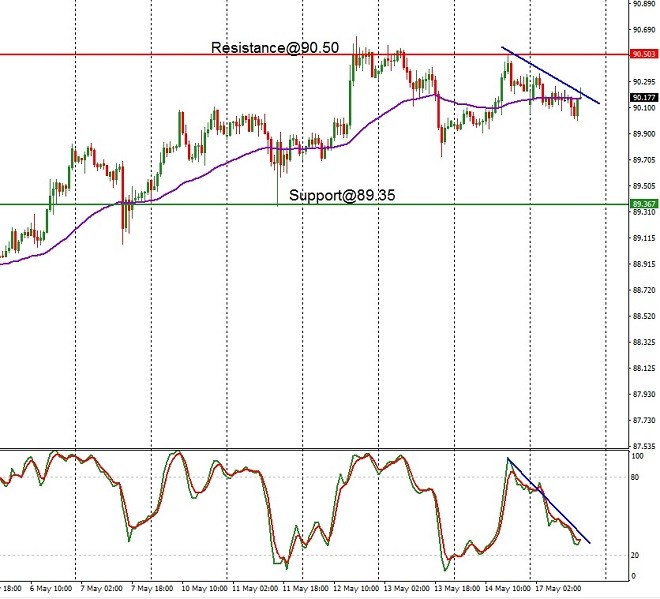
The robust PPI data from Japan and lower-than-anticipated housing starts data from Canada is expected to keep the CAD/JPY pair range-bound with a slight-bearish bias.
Technically, the CAD/JPY pair is declining after failing to cross above the resistance level of 90.50. The following minor support is anticipated only near 89.35. Additionally, the currency pair is trading below the 50-day moving average, while the stochastic oscillator is declining towards the bearish zone. Therefore, we are anticipating the currency pair to remain in a downtrend in the near term.
Disclaimer: Any financial trading analysis offered here is our opinion and is not intended as advice or direction for investors. We cannot guarantee the success of any trades made as a consequence of this article, and we encourage traders to incorporate a strong money management strategy to limit losses when they enter the markets. Please use this article as part of your own research before formulating strategies prior to trading.