

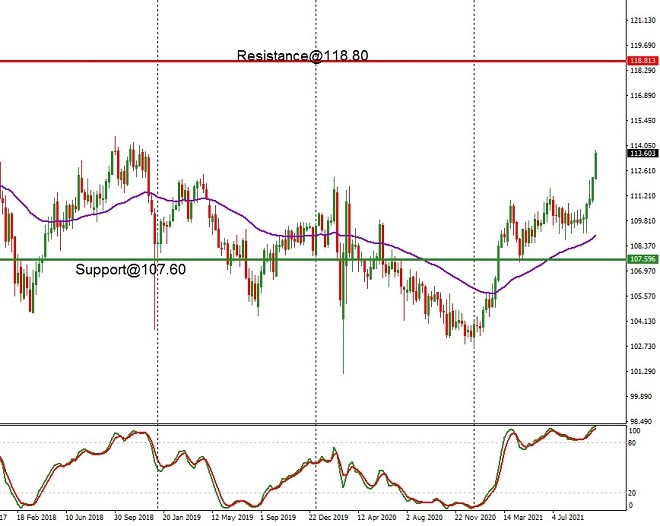
The Japanese yen declined against the greenback yesterday following the report of unexpected contraction in the core machinery orders for August. The yen’s downtrend continued for the rest of the day with the release of better-than-anticipated US consumer price index data for September. Overall, the USD/JPY rallied from a low of 113.34 to a high of 113.80 in the past 24 hours.
According to the Cabinet Office of Japan, core machinery orders declined 2.40% m-o-m in August, following a rise of 0.90% in the earlier month, and surprised economists who were anticipating growth of 1.60% for the reported period. The reported drop was the steepest in over five years.
The decline in machinery orders highlighted continuing pressure on businesses and the wider economy as companies faced difficulties in warding off the negative impact of the COVID-19 pandemic.
While presenting the data, for the first time, the government downgraded its evaluation of machinery orders by stating that there seems to be a pause in the sequence of rebounds.
Notably, supply chain issues and surge in raw material costs have pushed manufacturers’ sentiment to a six-month low in October. The country had recorded an annualized 1.90% economic growth in June quarter 2021. Economists anticipate only a paltry growth in the September quarter, reflecting sluggish private consumption.
Manufacturers’ orders fell by 13.40% m-o-m in August, reflecting the first decrease in five months, mainly due to a drop in demand from sectors such as shipbuilders, production, and electronic machinery. The reported figure represents the steepest decline since February 2016.
Non-manufacturers orders rose by 7.10% in August, following a 9.50% decline in July, driven by the demands from retail and wholesalers and logistics firms.
External orders, which are not categorized as core orders, dropped 14.70% following a 24.10% expansion in the earlier month.
Devoid of ships and electric utilities, on a y-o-y basis, core orders grew 17% in August and surpassed the 14.70% rise anticipated by economists.
In the US session, the Bureau of Labor Statistics stated that the consumer price index (CPI) increased 0.4% m-o-m in September, following a growth of 0.30% in the prior month and greater than the 0.30% rise anticipated by economists.
The food and shelter indexes accounted for over 50% of the overall increase. Specifically, the food index increased 0.90%, while the energy index grew 1.30%. Notably, the energy index recorded its fourth successive monthly growth.
On a y-o-y basis, the all-items index rose 5.40% in September. In the previous month, the all-items index increased 5.30% on a y-o-y basis. The energy index grew 24.80% year on year.
Excluding food and energy, the core CPI grew 0.20% m-o-m in September, following a rise of 0.10% in August, and met economists’ estimates. The motor vehicle insurance index increased 2.10% m-o-m in September, following a drop of 2.80% in August.
However, the airline fares index dropped 6.40% m-o-m in September, following a decrease of 9.10% in August. The medical care index remained unaltered in September.
Furthermore, on a y-o-y basis, devoid of food and energy, the core CPI increased 4% in September and matched the growth in August. The energy index rose by 24.80% y-o-y in September. Also, the food index grew 4.60% during the same period. The index for used cars and trucks rose by 24.40% in September. Likewise, the new vehicles index increased 8.70%, reflecting the largest yearly gain since September 1980.
The extremely poor Japan core machinery orders data is expected to keep the yen bearish against the greenback for the next few days.
The historical price chart indicates that the USD/JPY pair has bounced off the support at 107.60. The next major resistance is anticipated only near 118.80. Additionally, the stochastic oscillator is in the bullish zone. Therefore, we are anticipating the currency pair to remain in an uptrend in the days ahead.
Disclaimer: Any financial trading analysis offered here is our opinion and is not intended as advice or direction for investors. We cannot guarantee the success of any trades made as a consequence of this article, and we encourage traders to incorporate a strong money management strategy to limit losses when they enter the markets. Please use this article as part of your own research before formulating strategies prior to trading.


