
Video Source: Bloomberg Television on YouTube
Yesterday, the euro experienced a decline in value compared to the yen, triggered by the release of Italian industrial production data for July, which fell short of expectations. Concurrently, the Japanese machine tool order data for August also displayed unfavorable results, although they were marginally improved compared to the data from July.
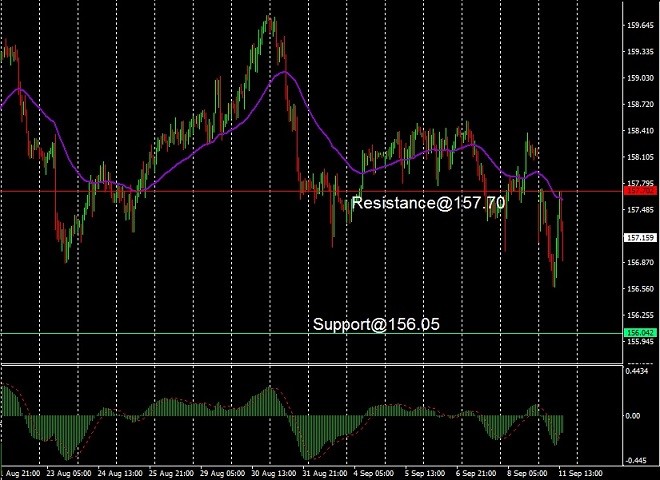
This modest improvement allowed the yen to make slight gains against the euro. It’s worth noting that the first day of the trading week saw no other significant economic data releases. In summary, within the last 24 hours, the EUR/JPY pair witnessed a decline, moving from a peak of 157.70 to a trough of 156.80.
According to the data published by the Bank of Japan, the M2 money stock grew by 2.50% y-o-y in August, unchanged from a similar increase in July and line with economists’ estimates. July’s reading was upwardly revised from 2.40%.
In value terms, the M2 money stock was ¥1,238.6 trillion in August.
Likewise, the M3 money stock rose by 1.90% y-o-y in August to ¥1,594.70 trillion. Additionally, the L money stock increased 2.20% y-o-y to ¥2.12 trillion. The adjusted money stock grew by 1.60% y-o-y to ¥2.114.6 trillion.
According to the preliminary data published by the Japan Machine Tool Builders’ Association (JMTBA), the country’s machine tool orders declined by 17.60% y-o-y in August to ¥114.75 million from a 19.80% decline in July. Domestic demand decreased by 9.40% y-o-y in August to ¥35,680 million. However, overseas demand increased by 5.50% to ¥79,066 million. Between January and August 2023, machine tool orders decreased by 16.40%.
Furthermore, Japan’s machine tool orders rebounded with a growth of 0.4% m-o-m in August, following a 6.40% contraction in July.
According to the data published by the Italian National Institute of Statistics, the country’s industrial production fell by 0.70% m-o-m in July, following a growth of 0.50% in the previous month and worse than forecasts of a 0.30% decline.
The industrial production index demonstrates a significant presence of certain sectors, primarily characterized by the metallurgy and metal product manufacturing industry, which holds a substantial weight of 14.4%, and the manufacturing of machinery and equipment not otherwise classified, accounting for 13.6% of the index.
Compared with the previous three months, Italy’s industrial production inched up 0.20% in the three months ended in July.
On a y-o-y basis, Italy’s industrial production declined by 2.10% in July 2023.
The weak Italian economic data is expected to keep the EUR/JPY pair range-bound with a slight bearish bias in the short term.
The historical price chart indicates that the EUR/JPY pair is descending after failing to break the resistance at 157.70. The next support is anticipated only near 156.05. Additionally, the currency pair is trading below its 50-day moving average, while the MACD indicator is showing a negative reading. Therefore, we anticipate the EUR/JPY pair to remain in a downtrend in the short term.
Disclaimer: Any financial trading analysis offered here is our opinion and is not intended as advice or direction for investors. We cannot guarantee the success of any trades made as a consequence of this article, and we encourage traders to incorporate a strong money management strategy to limit losses when they enter the markets. Please use this article as part of your own research before formulating strategies prior to trading.