

The Eurodollar declined against the pound yesterday following the report of worse-than-anticipated German retail sales data. The upbeat UK manufacturing PMI data indicating an expansion of the sector for the eighth month in a row enabled the pound to gain ground against the Eurodollar. In the last 24 hours, the EUR/GBP pair declined from a high of 0.8850 to a low of 0.8790.
According to Destatis, German retail sales declined 9.6% m-o-m in December, following an increase of 1.1% in the earlier month. The reported figure was worse than the 2% drop anticipated by economists. The sharp decline was mainly due to lockdowns enforced to contain the spread of the COVID-19 infections. The lockdown was implemented on December 16, 2020. On a y-o-y basis, retail sales increased 1.5% in December. Overall, in 2020, retail sales rose by 3.9% compared with 2019.
As per data published by IHS Markit, Spain’s manufacturing PMI (purchasing managers’ index) declined to 49.30 in January, from 41 in December, and missed the reading of 50.20 anticipated by economists. A reading below 50 indicates contraction and vice-versa. The reported reading reflects the manufacturing industry’s contraction for the second month in the last three months.
In a separate news release, the IHS Markit reported an increase in Italian manufacturing PMI (purchasing managers’ index) to a 34-month high reading of 55.10 in January, from 52.80 in December. Economists had anticipated a slight decline in the reading to 52.50 for the reported month. The reading reflects the robust growth of the manufacturing sector.
According to Istat (Italian National Institute of Statistics), Italy’s jobless rate inched upwards to 9% in December, from 8.8% in November. The reported unemployment rate was in line with economists’ forecasts.
The number of employed persons declined in December. On the contrary, the number of jobless and inactive people increased. The jobless rate of youth inched 0.3% to 29.7%.
Employment increased 0.2% q-o-q in the December quarter. This translates to an addition of 53,000 jobs during the October-December period. Overall, in the December quarter, the number of jobless people fell by 5.6%, or 137,000.
According to the IHS Markit, The French Final Manufacturing PMI increased to 51.60 in January, from 51.10 in December. Economists did not anticipate any change from the initial reading of 51.50. Despite a slight increase, the reading reflected an improvement in the French manufacturing sector’s condition for the last six months.
As per data published by IHS Market / BME Germany, the German final manufacturing PMI declined to 57.10 in January, from a three-year high of 58.30 in the prior month. Economists did not anticipate any change in the flash reading of 57.0. Despite indicating an expansion of the manufacturing sector, the reported reading was the lowest in four months.
Overall, the Eurozone final manufacturing PMI fell slightly to 54.80 in January, from 55.20 in December, but a notch higher than the initial reading of 54.70. The market had anticipated no change in the initial estimates. The reported figure reflects the highest level in over two-and-a-half-years.
The Eurozone manufacturing economy remained robust at the beginning of this year, with the industry recording growth for the seventh successive month. However, the rate of growth was the weakest in the last seven months.
While consumer goods producers recorded a marginal improvement in the operating environment, against the backdrop of a decline in fresh orders, the intermediate and investment goods industry posted substantial growth. As order book volumes increased at a brisk pace, backlog increased by another month. Supplier delivery times worsened for the 12th successive month. As a result, input prices increased on supply-side shortages.
Enterprises slashed their employee count, although at the slowest rate since June 2019. Confidence about the forthcoming 12 months improved to a three-year high hoping that the COVID-19 vaccine’s arrival will boost economic activity.
Commenting on the Eurozone final Manufacturing PMI data, Chris Williamson, Chief Business Economist at IHS Markit, opined: “Eurozone manufacturing output continued to expand at a solid pace at the start of 2021, though growth has weakened to the lowest since the recovery began as new lockdown measures and supply shortages pose further challenges to producers across the region.”
Across the Channel, the UK’s final manufacturing PMI decreased to a three month low of 54.10 in January, from a three-year high of 57.50 in the previous month, but higher than the initial reading of 52.90. Analysts had anticipated the initial reading to remain unaltered. Drop-in fresh orders affected the PMI. The reported reading reflected the eighth successive increase in manufacturing output. Nevertheless, the expansion pace declined to the lowest level in eight months as fresh orders declined slightly.
Notably, manufacturing employment increased for the first time in almost a year. However, the pace of job creation recorded only slight improvement. The supplier lead times, barring April 2020, increased to the highest level since the organization started reporting the PMI data three decades back.
According to the Bank of England, mortgage approvals were 103,000 in December, compared with 105,000 in November. Nevertheless, the reported number of mortgage approvals exceeded the figure of 100,000 anticipated by economists.
Even though house purchase approvals hit a historic low of 9,400 in May, mortgage approvals for house purchases increased to 818,500 in 2020, from 789,100 in 2019.
Net mortgage borrowing stood robust at £5.6 billion in December. Additionally, effective interest rates on fresh mortgage borrowing increased to 1.90%, reflecting the highest level since October 2019.
Consumer credit remained weak last year. Net repayments from individuals were £16.6 billion. Effective rates on new personal loans were 5.38% in December.
Private non-financial enterprises raised £1.6 billion from capital markets in December. The aggregate borrowing stood at £52.6 billion last year, sharply higher than the £7.4 billion in 2019.
Net bank borrowing by small and medium-sized businesses rose to £43.3 billion last year, compared with £1.4 billion in the prior year. Large companies recorded net repayments of £5.8 billion last year, compared with net borrowing of £13.8 billion in the earlier year. Household deposits rose by £20.9 billion in December, mirroring the most substantial level since May.
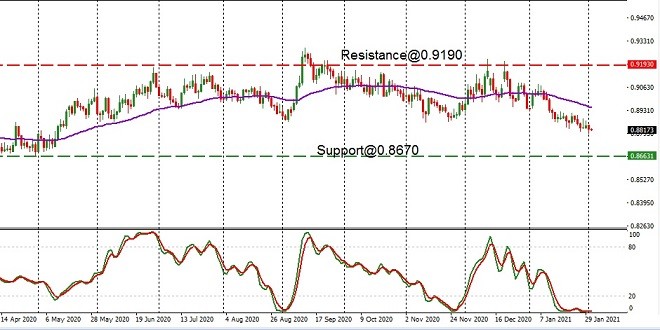
The weak German retail sales data is expected to keep the EUR/GBP pair range-bound with a slight bearish bias in the short-term.
The historical price chart indicates that the EUR/GBP pair is declining after facing stiff resistance at 0.9190. The next support is anticipated only near 0.8670. The currency pair trades below its 50-day moving average while the stochastics indicator is in the bearish zone. Therefore, we are expecting the EUR/GBP pair to decline further in the short-term.
Disclaimer: Any financial trading analysis offered here is our opinion and is not intended as advice or direction for investors. We cannot guarantee the success of any trades made as a consequence of this article, and we encourage traders to incorporate a strong money management strategy to limit losses when they enter the markets. Please use this article as part of your own research before formulating strategies prior to trading.


