The euro remained range-bound against the greenback following the release of weak economic data from both Germany and the US. While the German factory order data for January failed to meet expectations, the US goods deficit widened more than anticipated in the same period. Overall, the EUR/USD pair traded between 1.0840 and 1.0950 in the past 24 hours.
According to Destatis, German factory orders plunged 11.30% m-o-m in January, following a surge of 12% in the previous month and worse than forecasts of a 6% decline. Economists fear that that country is heading towards a recession.
Notably, German factory orders increased by 2.30% in the three months that ended January 2024 compared with the previous three months.
On a y-o-y basis, German factory orders fell by 6% in January 2024.
Capital goods and intermediate goods orders declined by 13.10% and 9.30% in January 2024, respectively, compared with the previous month. Likewise, consumer goods orders fell 5.70% m-o-m in January.
Specifically, the monthly decline was led by a 33.20% decrease in electrical equipment orders in January. Other vehicle construction orders, particularly aircraft, ships, and trains, fell by 27.30%. Metal product orders decreased by 14.50% m-o-m in January. Mechanical engineering orders dipped by 4.70% in the same period. However, orders for the automotive sector rebounded with a growth of 4.20% in January after declining by 5.80% in December.
Overseas orders plunged by 11.40% m-o-m in January. Similarly, domestic orders dipped by 11.20%. Orders from the Eurozone declined by 25.70% m-o-m in January. On the contrary, orders from outside the Eurozone grew by 1.60% in the same period.
Furthermore, manufacturing sector sales decreased by 2% m-o-m in January. On a y-o-y basis, manufacturing sector sales fell by 3.50% in January 2024.
In the US, the Department of Labor stated that unemployment claims were 217,000 in the week ending March 2, unchanged from the previous week. The previous week’s figure was upwardly amended from 215,000 to 217,000.
The four-week moving average was 212,250, down 750 from the previous week’s average. The previous week’s average was upwardly amended to 213,000 from 212,500.
According to the data published by the US Bureau of Economic Analysis, the country’s trade deficit widened to $67.40 billion in January from $64.20 billion in the previous month. Economists had anticipated a narrowing of the US trade deficit to $63.40 billion.
January exports were $257.20 billion, up $0.30 billion from December. Likewise, January imports rose by $3.60 billion to $324.60 billion.
The goods deficit increased by $3 billion to $91.60 billion in January. However, the service surplus fell by $0.30 billion to $24.20 billion in the same period.
On a y-o-y basis, the goods and services deficit fell by $2.9 billion (or 4.1 percent) in January 2024. Exports declined by $1.0 billion (or 0.4%). Imports dipped by $3.9 billion (or 1.2%).
Goods exports totaled $171.80 billion in January, up $0.20 billion from the previous month. The increase was led by a $1.40 billion rise in exports of automotive vehicles, parts, and engines in January. However, exports of industrial supplies and materials decreased by $1.7 billion.
Services exports increased by $0.2 billion to $85.4 billion in January.
Goods imports were $263.40 billion in January, an increase of $3.10 billion from December. Capital goods imports grew by $3.10 billion. Likewise, imports of automotive vehicles, parts, and engines rose by $2 billion. However, imports of industrial supplies and materials decreased by $1.3 billion.
Services imports increased by $0.5 billion to $61.3 billion in January.
The weak economic data from both countries is expected to keep the EUR/USD pair range bound in the short term.
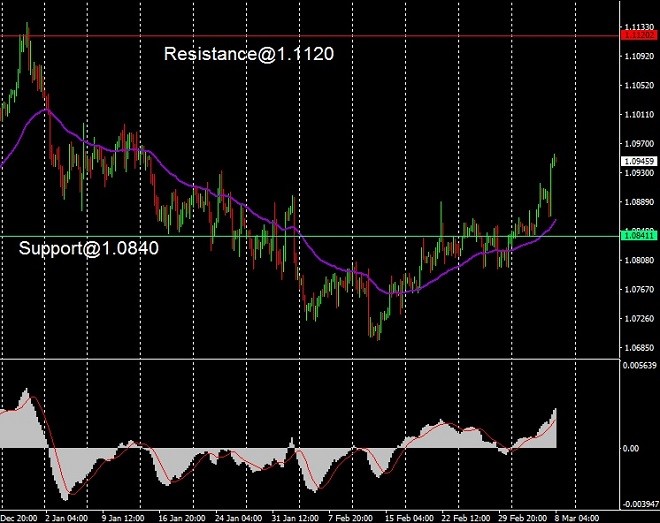
The historical price chart indicates that the EUR/USD pair is ascending after testing the support at 1.0840. The next resistance is anticipated to be only near 1.1120. Additionally, the currency pair is trading above its 50-day moving average, while the MACD indicator is showing a positive reading. Therefore, we anticipate the EUR/USD pair to remain in an uptrend in the near term.
Disclaimer: Any financial trading analysis offered here is our opinion and is not intended as advice or direction for investors. We cannot guarantee the success of any trades made as a consequence of this article, and we encourage traders to incorporate a strong money management strategy to limit losses when they enter the markets. Please use this article as part of your own research before formulating strategies prior to trading.