

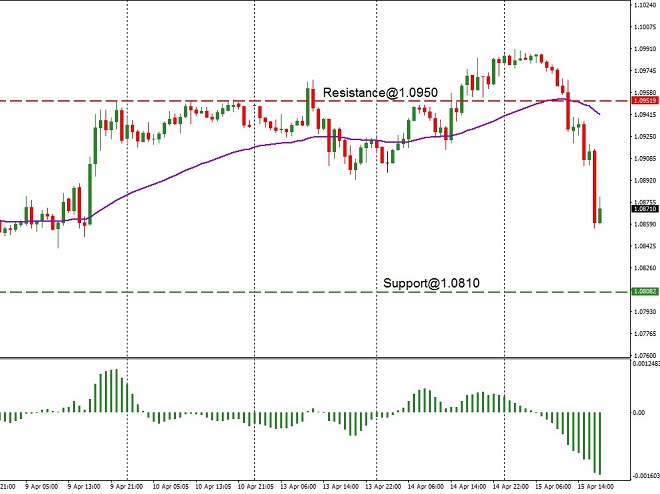
The Eurodollar lost ground against the greenback despite the release of extremely poor retail sales, capacity utilization, and industrial production data from the US. In the past 24 hours, the EUR/USD pair declined from a high of 1.0990 to a low of 1.0860.
According to the US Census Bureau, core retail sales dropped 4.5% m-o-m in March, after decreasing by 0.4% in the earlier month. Economists had anticipated core retail sales to decline by 4.9%. Compulsory business shutdowns to limit the spread of the COVID-19 outbreak weakened demand for several goods. Consumer spending dropped to its lowest level in more than a decade.
Retail sales plummeted 8.7% in March, representing the steepest decline since the government began publishing the figures in 1992. In the earlier month, retail sales decreased by 0.4%. Economists had anticipated retail sales to decrease by 8%.
The Federal Reserve Bank of New York published the Empire State Manufacturing Index, which indicated that the figure for April has slumped to -78.2, from 21.5 in the earlier month. Economists had anticipated the Empire State Manufacturing Index reading to decrease to 35.20. It is the lowest reading ever recorded. While fresh orders and shipments decreased at a historical rate, delivery times increased, and inventories declined.
Employment levels fell at a historic rate. However, enterprises anticipate the business environment to improve slightly in the next six months. It is the second consecutive decrease in the Empire Index as the coronavirus-associated closures affected the factory sector in an extreme manner. The earlier lowest level for the index was -34.30 recorded during the Great Recession of 2007-2009.
The poll identified that 85% of manufacturers felt that the business environment had dropped to its lowest, while only 7% felt that there is an improvement in the situation.
Oren Klachkin, an economist at Oxford Economics, said: “Manufacturing has never been in worse shape. Severely depressed demand, supply disruptions, and extremely high uncertainty will keep manufacturing on an extremely weak trajectory in the near term.”
Likewise, the capacity utilization rate fell to 72.7% in March, from 77% in the prior month. Economists had anticipated a decline in capacity utilization to 73.7%. The reported figure was the lowest since the Great Recession of 2007-09. Economists surveyed by MarketWatch anticipated a 4.1% decrease in production and capacity utilization rate of 73.8%.
Manufacturing production declined 6.3% in March, the largest decline since February 1946. Several key industries recorded decreases. Production of motor vehicle and spare parts decreased by 28%. Mining output dropped 2% in March, and utility production declined by 3.9%.
The Federal Reserve also stated that industrial production contracted 5.45% in March, after expanding 0.5% in February. Economists had anticipated industrial production to contract by 4.1%.
The weak economic data and rising COVID-19 cases in the US are expected to keep the US dollar range-bound against the euro in the days ahead.
Technically, the EUR/USD pair is declining after facing resistance at 1.0950. The next support is anticipated near 1.0810. The currency pair is trading below its 50-day moving average. Additionally, the MACD indicator also has a negative reading. Therefore, we are anticipating the EUR/USD pair to decline further in the short-term.
Disclaimer: Any financial trading analysis offered here is our opinion and is not intended as advice or direction for investors. We cannot guarantee the success of any trades made as a consequence of this article, and we encourage traders to incorporate a strong money management strategy to limit losses when they enter the markets. Please use this article as part of your own research before formulating strategies prior to trading.


