
The Eurodollar gained ground against the yen yesterday following the release of better-than-anticipated Eurozone trade surplus data. Notably, the market discarded the Eurozone industrial production data, which missed estimates, as the market anticipates COVID-19 vaccination drive could boost economic activity in the weeks ahead.
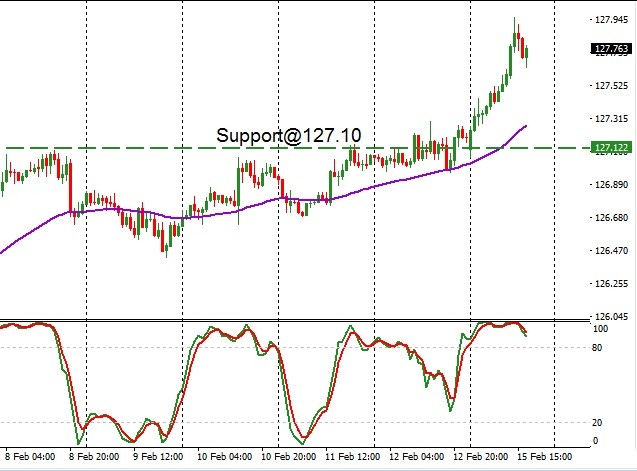
Notably, earlier in the Asian session, the Japanese Cabinet Office reported better-than-anticipated GDP data for the December quarter. In the last 24 hours, the EUR/JPY pair rallied from a low of 127.10 to 127.80.
According to the preliminary data published by the Cabinet Office of Japan, the country’s economy grew 3% q-o-q in the December quarter, followed by a 5.3% expansion in the September quarter and surpassed the 2.4% rise anticipated by economists.
Nominal GDP rose by 2.5% and surpassed the 1.9% growth anticipated by economists.
Likewise, the GDP price index increased 0.2% y-o-y in the December quarter, versus a 0.5% rise anticipated by economists. In the September quarter, the GDP price index grew 1.2% on a y-o-y basis.
During the December quarter, Japan’s recent economic rebound managed to hold on. The GDP managing to post double-digit growth as exports surged and firms began to increase capital expenditures. Notably, the government stimulus also aided consumer spending despite increased COVID-19 infections during the winter season.
On an annualized basis, the GDP rose by a yearly 12.7% q-o-q in the December quarter, beating the 10.1% growth anticipated by economists.
Private consumption increased 2.2% q-o-q in the December quarter, slightly above the 2% growth forecast by economists. Business investment increased 4.5%, almost double the 2.4% increase expected by the market.
Inventories contributed negative 0.4% to GDP growth, double the negative 0.2% impact anticipated by economists. Goods and services export contributed 1% to non-annualized GDP growth, beating economists’ forecast for a 0.9% rise.
There is a general feeling that the resurgence in COVID-19 infections could push the economy into recession again. The robust performance at the end of 2020 indicates that the rebound could happen in a comparatively healthy manner once Japan exits emergency enforced in Tokyo and other major cities in the country.
The growth in the previous quarter was led by a sharp improvement in trade, particularly with China. While business investment is witnessing a substantial rise seen in over five years, a rebound in household spending, assisted by government aid to dine out and travel, is also happening.
Considering the continuous decline in COVID-19 infections, economists anticipate restrictions to be lifted before March 7. In December, the country’s Prime Minister Yoshihide Suga rolled out a $700 billion stimulus package currently believed to be supporting economic activities. Other measures such as government loan guarantees and furlough subsidies have played a significant role in bringing down the unemployment rate to 2.9% and slash bankruptcies.
Interestingly, the country’s central bank, the Bank of Japan, downwardly revised its economic forecast for the current fiscal year but upwardly revised its estimates for the forthcoming years.
According to Japan’s Ministry of Economy, Trade, and Industry (METI), the country’s industrial production (revised estimates) contracted by 1% in December, compared with a decline of 0.5% in the previous month. The initial estimates pegged the industrial decline at 1.6%. Economists had anticipated no change in the initial reading of -1.6%.
On a y-o-y basis, Japan’s industrial production (final) declined 2.6% in December 2020, slightly better than the initial estimates of -3.2%. Capacity utilization increased 0.8% m-o-m in December. However, on a y-o-y basis, capacity utilization decreased 0.1% in December 2020.
Eurostat, the Eurozone industrial production contracted 1.6% m-o-m in December, following an expansion of 2.6% in the prior month and worse than the 0.4% drop anticipated by economists.
On a y-o-y basis, the Eurozone industrial production declined by 0.8% in December 2020. Furthermore, compared to 2019, the Eurozone industrial production contracted 8.7% in 2020.
The monthly decline was led by a drop of 3.1% in capital goods. Likewise, non-durable consumer goods decreased by 0.6%. Nevertheless, durable consumer goods’ production rose by 0.8%, energy by 1.4%, and intermediate goods by 1%.
The yearly drop was led by a decline of 3.9% in non-durable consumer goods, 3.1% in capital goods, and 1.9% in energy. However, production of durable consumer goods and intermediate goods increased 1.4% and 4.1%, respectively.
Eurostat stated that in a separate news release, the Eurozone trade surplus was €27.50 billion in December, compared with an abundance of €24.90 billion in the prior month. The reported figure surpassed the €22.30 billion surpluses anticipated by economists.
Exports from the Eurozone increased 2.3% y-o-y to €190.7 billion in December 2020, reflecting the first rise since pre-pandemic February 2020. However, imports declined 1.3% to €161.5 billion.
The mixed economic data from Europe and Japan is expected to keep the EUR/JPY pair range-bound with a slight bullish bias.
Technically, the EUR/JPY pair has broken the long-term resistance at 127.10. The next resistance is anticipated only near 131.20. Additionally, the currency pair is trading above its 50-day moving average, while the stochastics indicator is in the bullish zone. Therefore, we are anticipating the currency pair to rally in the days ahead.
Disclaimer: Any financial trading analysis offered here is our opinion and is not intended as advice or direction for investors. We cannot guarantee the success of any trades made as a consequence of this article, and we encourage traders to incorporate a strong money management strategy to limit losses when they enter the markets. Please use this article as part of your own research before formulating strategies prior to trading.


