
The Japanese yen rose against the Eurodollar following the report of better-than-anticipated producer price index data.
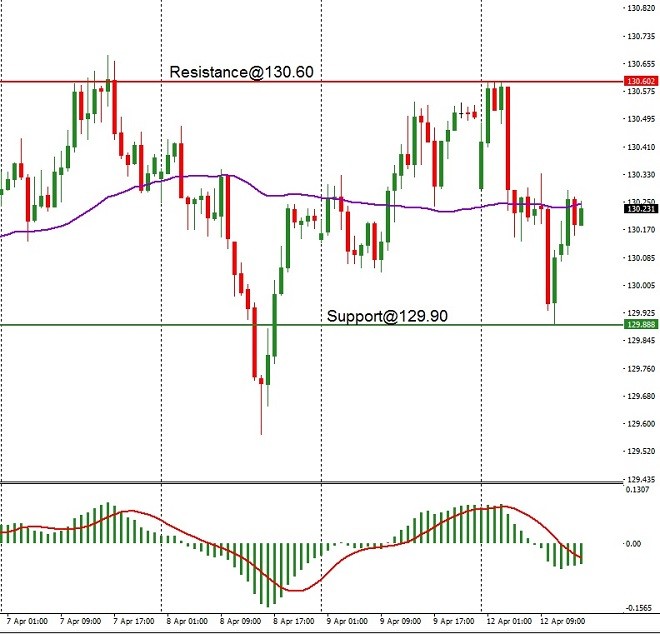
However, the robust Eurozone retail sales data published during the European session enabled the Eurodollar to regain the lost ground against the yen. In 1 day, the EUR/JPY pair remained range-bound between 130.24 and 130.60.
The Bank of Japan stated that bank lending amplified 6.3% y-o-y in March, following 6.2% in the prior month. The reported reading was in line with economists’ estimates.
The increase was led by restaurants and hotels that received additional loans to mitigate the negative impact of the COVID-19 pandemic.
Bank deposits increased 9.9% in March as households continued with the saving trend to safeguard themselves from an uncertain situation caused by the COVID-19 outbreak.
Japan’s four top categories of banks, including “shinkin” or credit unions, had outstanding loans of ¥579.995 trillion ($5.29 trillion).
Notably, the launch of a new program that provides incentives to banks to route additional funds to COVID-19 hit companies is yet to have a crucial effect on bank lending.
In a separate news release, the BoJ specified that the producer price index rose by 1% y-o-y in March, following a decline of 0.6% in the prior month and twice the 0.5% growth forecast by economists.
As per the data published by the Japan Machine Tool Builders Association (JMTBA), tool orders increased 65% y-o-y in March, following a 36.7% rise in February.
According to Eurostat, retail sales increased 3% m-o-m in February, following a decline of 5.2% in the previous month and surpassed the 1.3% growth anticipated by economists.
The volume of retail trade rose by 6.8% for non-food products. Likewise, automotive fuels posted a 3.7% increase. On the contrary, food, drinks, and tobacco posted a 1.1% decline.
On a y-o-y basis, the retail sales fell by 2.9% in February 2021. Automotive fuels reported a 13% decrease in volume. Similarly, non-food products recorded a 5.5% drop in retail sales. On the contrary, food, drinks, and tobacco recorded a 1.9% growth in retail trade volume.
The solid financial data from Europe and Japan is anticipated to keep the EUR/JPY pair range-bound in the short term.
The historical price chart indicates that the currency pair is trading below its 50-day moving average. The MACD indicator also has a bad reading. So, the currency pair is anticipated to decline and retest the support level of 129.90 in the days ahead.
Disclaimer: Any financial trading analysis offered here is our opinion and is not intended as advice or direction for investors. We cannot guarantee the success of any trades made as a consequence of this article, and we encourage traders to incorporate a strong money management strategy to limit losses when they enter the markets. Please use this article as part of your own research before formulating strategies prior to trading.