The pound is nose-diving against the currencies of developed currencies as prospects of a no-deal Brexit is becoming possible in the view of investors, who are offsetting the risk of the Pound attaining parity with the Euro if the UK gets detached from the EU. The worsening situation and the impact of a no-deal Brexit have been detailed in a report published by the Bank of America Merrill Lynch (BAML). According to the study, Britain’s unplanned exit from the EU could result in central banks across the globe selling off as much as £100 billion.
Brexit and its impact on the pound
The UK, which has voted to leave the EU, is scheduled to exit at 11 pm UK time on the 29th of March 2019. Temporarily, the UK and EU have come to an understanding of the three “divorce” issues, namely the amount owed by the UK to the EU, the future of the Northern Ireland border, and the status of the UK citizens residing in the EU and vice versa.
Currently, talks are focused on permanently fixing those issues. The Northern Ireland border issue is the most complex of these three matters. Both parties are trying to work out an agreement that will avoid a physical border between Northern Ireland and the Republic of Ireland.
Furthermore, a time frame of 21-months, referred to as the ‘transition period,’ has been set aside for negotiations. In public, the UK and the EU still say that an agreement is possible before October the 18th when the main EU summit will begin. However, behind the scenes, officials on either side acknowledge that it is unlikely to reach an agreement on time.
If the final draft is not ready by October, then December the 13th has been set as the fallback option. The officials are now targeting November for finalizing the agreement, as revealed by people who spoke on condition of anonymity. Even if a draft of the deal is ready by November, the EU has to call for an emergency summit to discuss the draft.
If the negotiations drag to December and January, then either of the parties should have to make considerable concessions or withdraw from the talks. As of now, the 29th of March 2019 is when the UK will exit, whether there is a deal or not. If everything goes as per plan, then the transition period will last until midnight of the 31st of December 2020.
The UK negotiator, Brexit secretary, Dominic Raab, has already expressed frustration over the lack of availability of his counterpart Michel Barnier for lengthy face-to-face talks. Last week, the British cabinet minister was able to enter into discussions with Barnier for only for two hours. Ironically, Barnier emphasizes the need to finalize a deal by the beginning of November, at the latest. Investors are worried that this is not going to happen and the UK could exit empty-handed.
On the economic front, the UK economy is struggling to deliver an increase in wage growth. Even though the unemployment rate is near a 43-year low, the wage growth remains the lowest in a year. The annual growth rate of total pay has declined by a notch to 2.4%, from 2.5% in 2Q18. Likewise, the regular growth pay has decreased from 2.8% to 2.7% even though the overall vacancies have increased to 829,000.
The number of EU nationals working in the UK has dropped by 86,000. The chances of a no-deal Brexit have already pushed inflation above the central bank’s target of 2%. Rising fuel prices are also pushing up inflation, with the consumer price index recording an annual rate of 2.5% last month.
Analysts fear that the deteriorating situation may encourage central banks across the globe to decrease their pound reserves. In its report, BAML has stated that central banks hold as much as £388 billion (~$500 billion), representing 4.5% of total central bank reserves. Furthermore, BAML has stated that Sterling made up 3.6% of global reserves (on average) since 1995. Even a 1% dilution by central banks means that as much as £100 billion pounds will enter the currency market.
Bank of America Merrill Lynch (BAML) stated: “In a scenario that central banks adjust their sterling holdings back to the long-term average (3.6 percent), this suggests that they could sell upwards of 100 billion pounds in sterling reserves on a no-deal scenario, all else being equal.”
In the meantime, the US economy is performing exceptionally well. The GDP growth is expected to stay at about 3% this year. With another Fed hike anticipated in September, the greenback continues to remain strong against the euro, yen, and the pound.
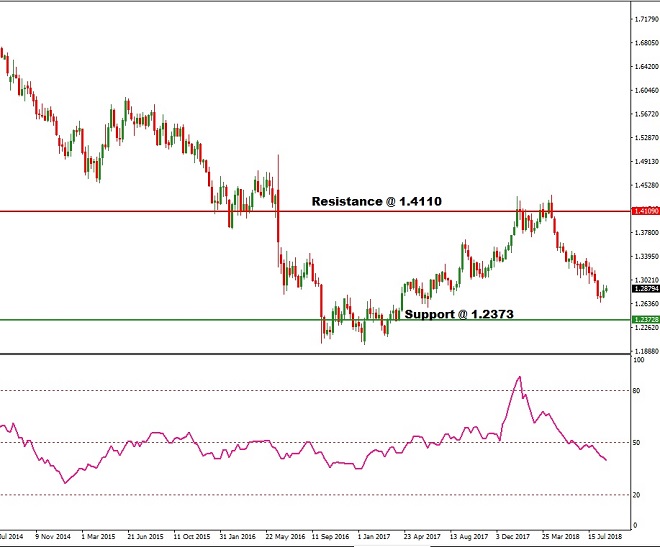
Technically, the GBPUSD pair is on a decline, with the money flow indicator below the reading of 50. Therefore, a trader can expect the GBPUSD pair to decline further.
Disclaimer: Any financial trading analysis offered here is our opinion and is not intended as advice or direction for investors. We cannot guarantee the success of any trades made as a consequence of this article, and we encourage traders to incorporate a strong money management strategy to limit losses when they enter the markets. Please use this article as part of your own research before formulating strategies prior to trading.