The Aussie weakened against the greenback yesterday after the country’s capital expenditure dropped unexpectedly in the Q2 2019 as strong investment growth in equipment and machinery was negated by sluggish spending on buildings. The increase in import duties on Chinese goods by the US has also complicated the situation for Australia which is highly dependent on the Chinese economy for its commodity shipments.
According to the Australian Bureau of Statistics, total new capital expenditure fell 0.5% on a q-o-q basis in the second quarter, missing economists’ expectations for an increase of 0.4%.
Investment in building and structures dropped 3.3%. On the contrary, plant and machinery investment increased 2.5%. On an annualized basis, overall capital expenditures declined 1% in the second quarter of 2019. Nevertheless, enterprises upwardly revised their investment plans for 2019-20. As per third estimate, Capex was A$113.40 billion, up 14.9% greater than second estimate.
The recent assessment for 2018-19 was A$112.10 billion, down 0.1% from an earlier estimate. Marcel Thieliant, an economist at Capital Economics opined that despite a likely decline in capital spending in 2019-20, the friction would begin to moderate in the forthcoming quarters.
Notably, construction work data published earlier this week was weaker than expected, negating the positive sentiment created by net exports estimate and equipment spending forecast.
In addition to the poor economic data, the Australian economy is also caught in between the US-China trade war. China is the largest trading partner of Australia.
Last Friday, China stated that it would raise import duty on $75 billion worth US goods. American President Donald Trump retorted by announcing a 5% hike in import duty on nearly $550 billion worth Chinese products.
Specifically, prevailing import duties on $250 billion Chinese products was increased to 30%, from the existing 25%. Likewise, planned import duties on $300 billion worth Chinese goods were increased to 15%. The newly announced levies will become effective on September 1st. The President also suggested US enterprises shift their operations out of China.
Next week (September 4th), the statistical office is scheduled to release quarterly national accounts for Q2 2019. In the first quarter, the GDP grew only by 0.4%. Westpact analyst Andrew Hanlan expects the economy to expand by 0.5% in the second quarter. Until that data is released, the bearish trend in the AUD/USD pair is likely to continue.
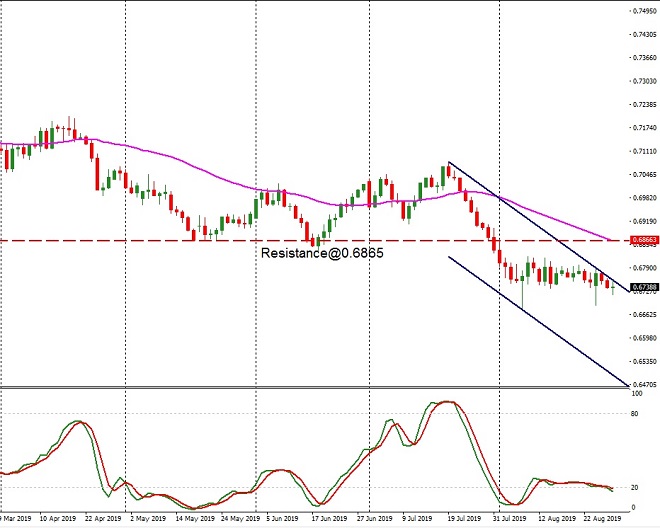
Technically, the AUD/USD pair has broken the support at 0.6865. Furthermore, the currency pair is also trading below its 50-day moving average. The stochastic oscillator is also in the bearish zone. As a result, we can expect the currency pair to move down in the short-term.
Disclaimer: Any financial trading analysis offered here is our opinion and is not intended as advice or direction for investors. We cannot guarantee the success of any trades made as a consequence of this article, and we encourage traders to incorporate a strong money management strategy to limit losses when they enter the markets. Please use this article as part of your own research before formulating strategies prior to trading.