
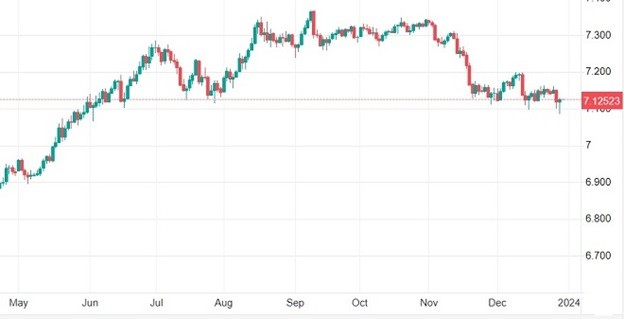
The greenback gained ground against the Chinese yuan on the first trading day of the year following the release of mixed economic data from China. While manufacturing PMI unexpectedly declined in December, the services PMI gained ground in the same period. There were no other economic releases yesterday. Overall, the USD/CNY pair gained 0.09% in the past 24 hours to trade at 7.1252.
According to the data published by the National Bureau of Statistics (NBS) of China, the country’s composite PMI (purchasing managers’ index) output inched down to 50.30 in December from 50.40 in November. The reported reading was the lowest in a year as the economic rebound was jittery, with factory productivity contracting by the highest level in six months while the service sector was growing for twelve successive months.
The recent figure underlined that the post-pandemic rebound on the mainland remains jittery due to consistent property issues, increasing deflationary pressures, weakening local currency, and soft worldwide demand, all reviving pleas for another round of stimulus from Beijing. In the last few months, China has announced a plethora of policy changes to fuel domestic demand and released government bonds to support infrastructure investment, but economists have stated that the quantum of the fund release was not adequate. In the meantime, the central bank, since June 2022, has rolled out a series of policy changes, including small cuts in interest rates and large cash infusions.
In a separate news release, the NBS stated that China’s non-manufacturing PMI inched up to 50.40 in December from an 11-month low of 50.20 in November. The reported figure reflects the 12th successive month of growth in service activity, against the backdrop of continued assistance initiatives and policy changes spanning the year from the government to fuel a sluggish economic rebound.
Foreign orders increased for the first time in eight months, with the index inching up to 50.90 in December from 46.90 in November. The fresh orders index grew to 47.50 in December from 47.20 in November. However, the employment index inched up to 47.10 from 46.90. Concurrently, the delivery time index fell to an 11-month low of 51.80 in December. Interestingly, the sentiment index rose to a 6-month high of 60.30 in December from 59.80 in November.
The NBS also stated that manufacturing PMI in China unexpectedly declined to 49 in December from 49.40 in November, missing economists’ estimates of 49.50. The reported reading reflects the third successive month of decline in factory output and the steepest decline in six months. The decline was led by a failed rebound led by weakness in the property market, rising worldwide headwinds, and deflationary threats.
Fresh orders declined for the third successive month, with the pace of drop being the steepest since June. The corresponding index fell to 48.70 from 49.40. Overseas sales fell for the ninth consecutive month, with the corresponding index inching down to 45.80 in December from 46.30 in November. The employment index decreased to 47.10, reflecting the 10th successive month of a decrease from 48.10. Overall, the sentiment index rose to 55.90, the highest level since February, from 55.80.
The mixed economic data is expected to keep the USD/CNY pair range-bound in the short term.
Disclaimer: Any financial trading analysis offered here is our opinion and is not intended as advice or direction for investors. We cannot guarantee the success of any trades made as a consequence of this article, and we encourage traders to incorporate a strong money management strategy to limit losses when they enter the markets. Please use this article as part of your own research before formulating strategies prior to trading.