
The Chinese yuan lost ground against the greenback yesterday following the release of mixed economic data from China. Notably, China’s second-quarter GDP growth missed estimates. Additionally, the country’s retail sales hit a 17-month low of 2%, signaling a considerable slowdown in consumer spending.
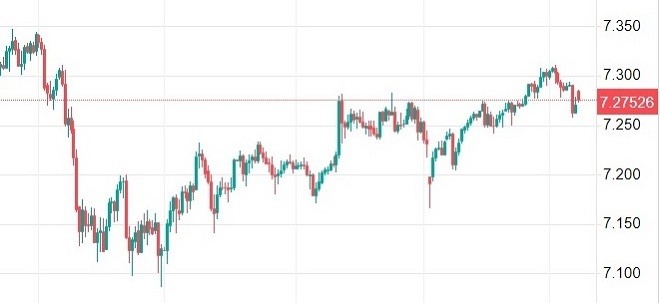
Regarding THE monetary policy, the People’s Bank of China left the medium-term lending facility rate unchanged at 2.50%, in line with economists’ expectations. There were no other major economic releases yesterday. Overall, the Chinese yuan fell to a low of 7.3615 before recovering to 7.27 levels.
According to China’s National Bureau of Statistics (NBS), the country’s economy expanded 4.70% y-o-y in the March 2024 quarter after rising 5.30% in the previous quarter, missing forecasts of 5.10% GDP growth. On a q-o-q basis, China’s economy inched up 0.70% in the March 2024 quarter.
As per the preliminary estimates, China’s GDP was yuan 61.684 trillion in 1H 2024, an increase of 5% on a y-o-y basis. The value added by the primary industry reached 3,066.0 billion yuan, representing a 3.5 percent increase year-on-year. The secondary industry achieved a value of 23,653.0 billion yuan, reflecting 5.8 percent growth. Meanwhile, the tertiary industry contributed 34,964.6 billion yuan, marking a 4.6 percent rise.
In 1H 2024, the value added by agriculture increased by 4% compared to the previous year. China’s exports saw a higher-than-anticipated rise of 8.6 percent year-on-year. However, imports in June declined by 2.3% y-o-y, contrary to the anticipated slight growth. For 1H 2024, the cumulative value of imports and exports of goods amounted to 21,168.8 billion yuan, reflecting a 6.10% y-o-y increase. The cumulative value of exports reached 12,129.8 billion yuan, reflecting a rise of 6.90%, while imports totaled 9,039.0 billion yuan, an increase of 5.20%. The trade balance showed a surplus of 3,090.9 billion yuan.
China’s consumer price index inched up 0.20% y-o-y in June. On an m-o-m basis, China’s consumer price index fell by 0.20% in June. Excluding volatile items such as food and energy prices, the country’s core CPI grew by 0.60% y-o-y in June, easing from the 0.70% increase in 1H 2024. Notably, in 1H 2024, China’s consumer price index inched up 0.10% on a y-o-y basis.
In particular, food, tobacco, and alcohol prices fell by 1.40% y-o-y in 1H 2024. Clothing prices grew by 1.60% in the same period. Similarly, housing, articles, and services for daily use rose by 0.20% and 0.90%, respectively. However, transportation and communication decreased by 0.70%.
The NBS also stated that China’s retail sales increased 2% y-o-y in June following a 3.70% increase in the previous month, missing forecasts of 3.30% growth.
China’s cumulative retail sales of consumer goods grew by 3.70% y-o-y in 1H 2024 to yuan 23,596 billion.
According to the data published by the NBS, China’s industrial production increased by 5.30% y-o-y in June, following a 5.60% rise in the previous month, surpassing forecasts of 5% growth. The increase was led by mining, which grew by 2.40% y-o-y in June. Likewise, manufacturing surged 6.50% in the same period. Production and supply of electricity, thermal power, gas, and water rose by 6% y-o-y in June. China’s services grew by 4.60% y-o-y in 1H 2024.
The People’s Bank of China further stated that the country’s household loans increased by 1.46 trillion yuan (or ~$200 billion) in 1H24, more than 50% of the yuan 2.80 trillion in new household loans in 2023.
The NBS also stated that China’s unemployment rate stood at 5% in June, unchanged from the previous month and in line with the market’s expectations. The urban employment rate was 5.10% in 1H 2024, a decrease of 0.10% from the March 2024 quarter and a decline of 0.20% from the comparable period of 2023.
The lower-than-anticipated GDP and retail sales data are expected to keep the USD/CNY pair range-bound with a slight bullish bias in the short term.
Disclaimer: Any financial trading analysis offered here is our opinion and is not intended as advice or direction for investors. We cannot guarantee the success of any trades made as a consequence of this article, and we encourage traders to incorporate a strong money management strategy to limit losses when they enter the markets. Please use this article as part of your own research before formulating strategies prior to trading.