

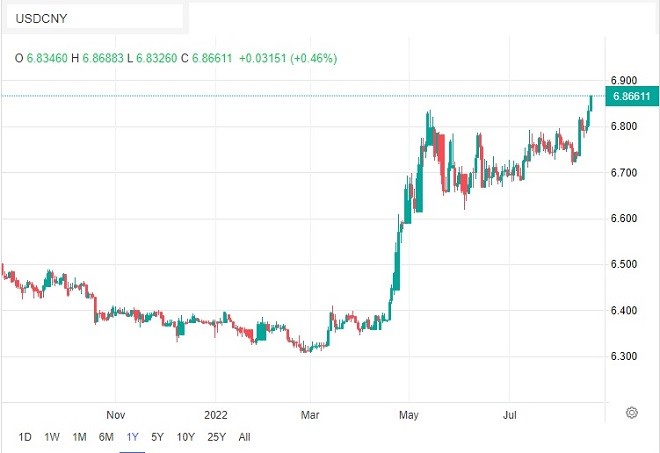
The greenback hit a five-week high against the yen yesterday before losing some of its gains as the Peoples Bank of China (PBoC) slashed prime loan rates. Notably, a week earlier, the central bank slashed two interest rates without any prior announcement. The rate cut is perceived as a step taken to boost credit demand, which has been declining due to COVID-19-related lockdowns and property sector issues. In the last 24 hours, the USD/CNY pair traded at 6.86493, up 0.03030 (or 0.44%) from its prior close. There were no other major economic releases yesterday.
The one-year LPR (Loan Prime Rate) was slashed to 3.65%, from 3.70%. Likewise, the five-year LPR was reduced by 15 basis points to 4.30%, from 4.45%. The rate cut was deeper than the 10 basis point reduction forecast by economists and comparable to May’s rate cut, reflecting the largest so far.
The five-year rate cut is expected to mainly affect residential mortgages. So, economists consider the rate cut as an attempt by the PBoC to revive borrowers’ confidence in the property sector. Interestingly, a major portion of fresh loans in China are based on a one-year LPR.
Several parts of China are facing dry weather, resulting in a drop in hydroelectric power production. This has aggravated the property sector’s problems. Specifically, the Sichuan province of China, which is known for its robust industrial activity, has been severely affected by power outages. The power usage limits have been extended to Thursday of this week from last Saturday.
As mentioned earlier, last Monday, the PBoC slashed the interest rate of one-year medium-term lending facility (MLF) loans (400 billion yuan) by 10 basis points, to 2.75%, from 2.85%.
Furthermore, the central bank also increased the liquidity in the market by a sum of 2 billion yuan via seven-day reverse repos and simultaneously slashed the borrowing rates by a similar margin of 10 basis points to 2%, from an earlier level of 2.10%.
The steeper-than-anticipated rate cut lifted sentiment in the market, with the Hang Seng Mainland Properties index traded in Hong Kong rising by 1.40%.
Economists have cautioned that the rate cut is not adequate to resolve the fundamental issues and make property investors confident in China’s developers. Several companies are yet to complete the construction of houses that have been sold (aka cash received) some time back.
The rate cut is expected to keep the USD/CNY pair slightly bullish in the short term.
Disclaimer: Any financial trading analysis offered here is our opinion and is not intended as advice or direction for investors. We cannot guarantee the success of any trades made as a consequence of this article, and we encourage traders to incorporate a strong money management strategy to limit losses when they enter the markets. Please use this article as part of your own research before formulating strategies prior to trading.


