

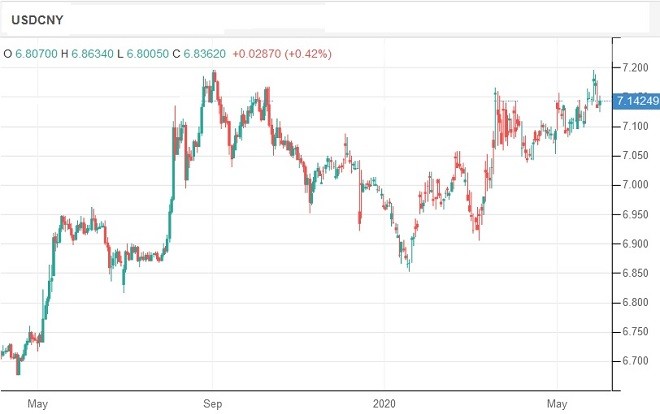
The Chinese yuan rose 0.05% to 7.1279 against the greenback on Monday after the PBoC (People’s Bank of China) set the onshore rate at a 12-year low of 7.1315. One of the reasons for the yuan gaining ground, instead of losing against the greenback, was that the US-China tensions lessened mildly as the US government’s response to China’s new security laws for Hong Kong turned out to be more lenient than anticipated.
Notably, even the economic data, specifically better-than-anticipated Caixin China manufacturing PMI (purchasing managers’ index) data, also aided the yuan to hold ground against the greenback.
According to the China Federation of Logistics and Purchasing (CFLP), manufacturing PMI fell few notches to 50.6 in May, from 50.80 in the prior month. Economists had anticipated an improvement in the manufacturing PMI to 51.10. The figures indicate the issues faced by Chinese factories as the rebound from the coronavirus shutdown continues. As overseas orders for Chinese manufacturers are contracting, factory jobs will be on a decline.
The National Bureau of Statistics’ (NBS) manufacturing purchasing managers’ index (PMI), a measure of morale among the country’s huge industries, inched lower to 50.6 in May, from 50.80 in April. Even though the reported figure missed the Consensus estimate, it was still above 50, implying an expansion.
Total fresh orders continued to increase, with the index increasing to 50.90 in May, up 0.7% from the earlier month. But the gains were mainly due to domestic demand, with fresh overseas orders continuing to drop sharply. An index reflecting May’s export orders rose moderately to 35.30, from 33.50 in the prior month, but still reflecting a contraction in overseas demand.
The manufacturing employment index declined to 49.4, from 50.2, while non-manufacturing employment decreased a notch lower to 48.50 in May, from 48.6 in April. The figures indicate slight contraction and underline the issues faced by the government, which has made job creation the top priority for 2020. Notably, the government of China had decided not to set any growth target for 2020, after a gap of 18 years.
The CFLP also published the non-manufacturing PMI data, which reflects sentiment in services and construction sectors, rose to 53.6 in May from 53.20 in April. Economists had anticipated the non-manufacturing PMI to improve slightly to 53.50. Construction sector business activity hastened further in May, with the index surging to 60.8, from 59.70 in the earlier month, primarily due to the launch of state-backed infrastructure development ventures.
The NBS pointed out that businesses associated with tourism, sports, culture, and entertainment are yet to recover, and the corresponding indices remain low. Retail sales also declined 7.5% y-o-y in April and missed analysts’ estimates.
The Caixin Manufacturing PMI (purchasing managers’ index) Markit data, reflecting the manufacturing conditions, rose to 50.70 in May, from 49.40 in the earlier month. It was the highest reading since January as Covid-19 driven prohibitions were relaxed, with output increasing the most since January 2011.
Economists had anticipated a slight improvement in the composite indicator reading to 49.70. A reading above 50 indicates expansion and vice-versa. Lack of fresh orders led to the initial decrease in backlogs of work since February 2016, even though the rate of burnout was mild. The subdued demand forecast also drove companies to slash their employee count again in May.
The mixed economic data and unresolved geopolitical issues between China and the US are anticipated to keep the USD/CNY pair range-bound with a slight bullish bias in the short-term.
Disclaimer: Any financial trading analysis offered here is our opinion and is not intended as advice or direction for investors. We cannot guarantee the success of any trades made as a consequence of this article, and we encourage traders to incorporate a strong money management strategy to limit losses when they enter the markets. Please use this article as part of your own research before formulating strategies prior to trading.


