
Video Source: BNN Bloomberg on YouTube
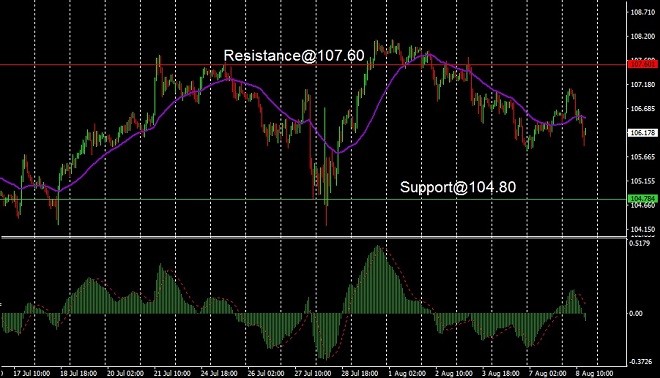
The Canadian dollar fell against the yen yesterday following reports of wider-than-anticipated trade deficit data for June. Japan’s economic data also reflected a struggling economy. However, Japan’s current account surplus in June was higher than anticipated. This enabled the yen to strengthen against the loonie. Overall, the CAD/JPY pair fell from a high of 107.10 to a low of 105.90 in the past 24 hours.
According to Japan’s Ministry of Finance, the country’s current account surplus increased to ¥1.508 trillion in June from ¥497.90 billion in May and surpassed forecasts of a surplus of ¥1.39 trillion. The reported figure reflects the fifth successive month of surplus in the current account. The increase was led by a rebound in goods account balance to a surplus of ¥3.29 trillion in Jun from a deficit of ¥11.05 trillion last year. Specifically, exports inched up 0.50% y-o-y in June. Imports fell by 14.30% in the same period.
Notably, the primary income surplus narrowed to ¥16.83 trillion in June from ¥18.49 trillion in a similar period last year. The services deficit widened to ¥3.58 trillion from ¥2.56 trillion. Furthermore, the secondary income recorded a deficit of ¥144.10 billion compared to a small surplus in the year-ago period.
According to the Bank of Japan, the country’s bank lending rose by 2.90% y-o-y in July following a 3.10% increase in the previous month but a notch lower than the 3.10% growth anticipated by economists. Notably, this is the second successive month of decline, with the outstanding loans held by the third largest economy’s top, domestic, and “shinkin” banks standing at ¥605.30 trillion.
Major and regional banks recorded loan growth of 3.10% and 3.40%, respectively, while “shinkin” banks posted a loan increase of 0.90%.
In a separate news release, Japan’s Statistics Bureau stated that the country’s household spending fell by 4.20% y-o-y in June, following a 4% decline in the previous month and worse than forecasts of a 3.90% decrease. This was the fifth decline in personal spending so far this year, against the backdrop of intense cost pressures.
Household spending on food declined 3.90% y-o-y in June. Also, housing fell by 2.90% in the same period. Furthermore, furniture and household utensils plunged 17.60%. While clothing and footwear decreased by 4.30%, medical care declined by 8.50%. Notably, culture and recreation fell by 2.50%. Additionally, education plunged by 9.60%.
During the same period, spending on fuel, light, and water charges eased to 0.60% in June. On the contrary, expenditures for transport and communication rebounded robustly by 3.90%.
On a m-o-m basis, household spending inched up 0.90% in June, surpassing the forecast of a 0.30% increase.
According to the data published by Japan’s Ministry of Health, Labor, and Welfare, the country’s average cash earnings rose by 2.30% y-o-y in June, following a 2.90% rise in the previous month but missing forecasts of 3% growth. Furthermore, special payments, including summer bonuses, increased by 3.50%.
The increase was delivered by a 27.50% surge in real estate and goods rental and leasing in June. Mining and quarrying of stone and gravel jumped 17.20%. Likewise, transport and postal activities grew by 12.90%.
According to Statistics Canada, the country’s merchandise trade deficit widened to C$3.70 billion in June from C$2.70 billion in May, worse than forecasts of a C$2.80 billion deficit.
Exports fell by 2.20% in June, following a 3% dip in the previous month. Nine out of 11 product categories recorded declines. Specifically, exports of metal and non-metallic mineral products fell by 8% in June. Additionally, exports of industrial machinery, equipment, and parts decreased by 5%. Similarly, exports of basic and industrial chemicals, plastic, and rubber products dipped by 5.70%. Also, exports of farm, fishing, and intermediate food products fell by 4.40%.
Service exports rose by 0.40% to C$14.70 billion in June. However, service imports fell by 0.20% to C$15.70 billion.
Canada’s imports decreased 0.50% in June, following a 3% increase in May. Seven out of 11 product categories posted declines. Specifically, imports of energy products plunged by 13% in June. Likewise, imports of consumer goods declined by 1.90% in the same period.
Combining both global trade in goods and services, exports fell by 1.70% to C$75.40 billion in June. Imports declined 0.40% to C$80.10 billion. As a whole, Canada’s trade deficit widened to C$4.70 billion in June from C$3.80 billion.
The weak economic data from both countries is expected to keep the CAD/JPY pair range bound in the short term.
The historical price chart indicates that the CAD/JPY pair is descending after failing to break the resistance at 107.60. The next major support is anticipated only near 104.80. Additionally, the MACD indicator is showing a negative reading. Therefore, we anticipate the currency pair to remain in a downtrend in the short term.
Disclaimer: Any financial trading analysis offered here is our opinion and is not intended as advice or direction for investors. We cannot guarantee the success of any trades made as a consequence of this article, and we encourage traders to incorporate a strong money management strategy to limit losses when they enter the markets. Please use this article as part of your own research before formulating strategies prior to trading.