
The Canadian dollar gained against the yen on the first day of the trading week despite the weak manufacturing sales data reported by Statistics Canada. The multi-year high crude oil price enabled the loonie to gain ground against the yen and other major currencies.
Notably, the Japanese Ministry of Economy, Trade and Industry (METI) issued better-than-anticipated industrial production data for April. However, the market continued to focus on surging crude prices. In the last 24 hours, the CAD/JPY pair rallied from a low of 90.10 to a high of 90.55.
According to Japan’s METI, revised industrial production increased 2.9% in April, following a growth of 2.5% in March and greater than the 2.5% rise anticipated by economists.
On a y-o-y basis, the index for industrial production increased 15.8% in April 2021, a slight upward revision from the 15.4% growth reported in the initial estimates on 31 May 2021.
The increase was led by business-focused machinery, communication instrument, electrical and production equipment.
Production indices for transport machinery, motor vehicles, and plastic goods declined in April. Food and tobacco, and chemicals led to a small increase in April, compared with March. As a whole, the ministry stated that “industrial production is picking up.”
In the US session, Statistics Canada stated that manufacturing sales declined 2.1% m-o-m in April, following a growth of 4% in the earlier month, and missed the 1.1% expansion anticipated by economists.
In value terms, manufacturing sales dropped to C$57.10 billion in April, led by a drop in sales in 11 out of 21 industries. A major portion of the decrease was due to a decline in the sales of transportation machinery and petroleum and coal products.
Even though the Canadian motor vehicle sector has been under the impact of worldwide scarcity of semiconductor chips, the negative effect worsened at the end of the first quarter, with almost all top automobile manufacturers having to stop or slow down production.
Motor vehicle sales declined 36.5% to C$2.30 billion in April, the biggest m-o-m decline since the month of April in 2020. In the motor vehicle parts sector, sales dropped 19% to C$1.90 billion, the weakest level since May 2020. The semiconductor chip scarcity is anticipated to last throughout the 2Q of 2021. The export of cars and vehicle spares declined 18.10% in April.
After six successive increases in a row, the sale of coal and petroleum products dropped 7.1% to C$5.10 billion in April due to maintenance shutdowns at some refineries. In spite of the drop, y-o-y sales increased 160.70% from the unexpected lows recorded in the initial wave of the COVID-19 pandemic.
Sales of non-metallic mineral products dropped 5.6% to C$1.40 billion, primarily due to a drop in sales in all sectors barring cement and concrete product manufacturing. Despite the drop, sales rose by 57.3% on a y-o-y basis.
Machinery sales increased 14.60% to C$3.70 billion in April, the highest level ever recorded. On a y-o-y basis, machinery sales rose by 29.30%. Wood product sales recorded a growth of 6.5% to a historical high of C$4.90 billion in April, led by an increase in the price of wood preservation and sawmill manufacturing, representing a major share of the increase.
Chemical sales increased 5% to C$5.10 billion in April, led by an increase in sales of basic chemicals and also synthetic rubber, resin, and artificial and synthetic filaments. Also, the food and primary metal industries posted a growth of 1.1% and 2.2%, respectively.
In the commodity market, Brent crude closed at a multi-year high of $73.25 on Monday. Likewise, WTI crude closed at $71.49. Experts anticipate a further upside as long as crude stays above $70 per barrel.
As Canada derives considerable revenue from the export of crude oil, the market discarded the negative economic data and continues to support the loonie. The scenario is expected to remain unaltered in the near term.
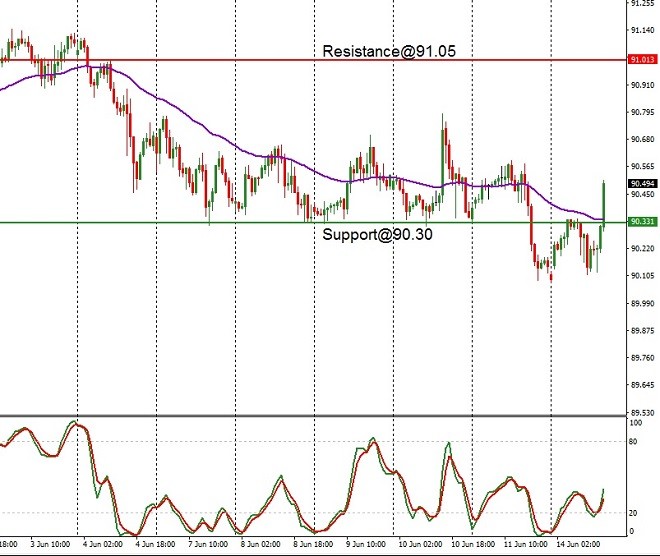
The historical price chart indicates that the CAD/JPY pair is surging after testing the support at 90.30. The next minor resistance is anticipated only near 91.05. Additionally, the stochastics indicator is also rising towards the bullish zone. Therefore, we are anticipating the currency pair to remain in an uptrend in the days ahead.
Disclaimer: Any financial trading analysis offered here is our opinion and is not intended as advice or direction for investors. We cannot guarantee the success of any trades made as a consequence of this article, and we encourage traders to incorporate a strong money management strategy to limit losses when they enter the markets. Please use this article as part of your own research before formulating strategies prior to trading.