
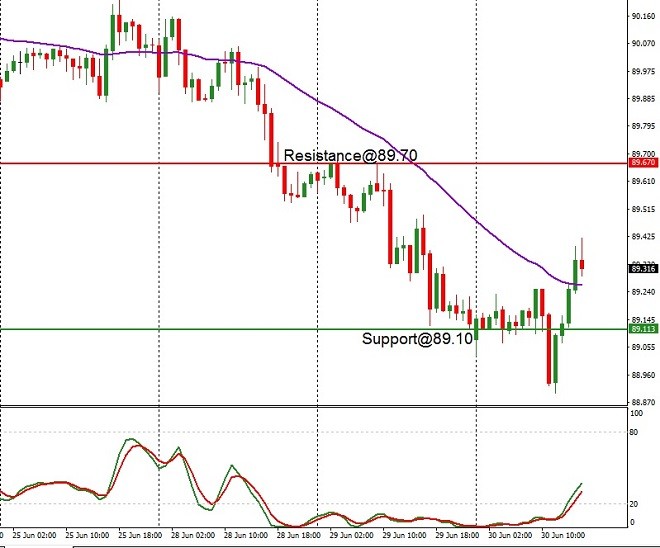
The Japanese yen rallied against the Canadian dollar in the Asian session yesterday following the release of strong consumer confidence and housing starts data from Japan. However, in the US session, the better-than-anticipated GDP data published by Statistics Canada enabled the CAD to regain the lost ground. In the past 24 hours, the CAD/JPY currency pair recorded a low of 88.90 and a high of 89.40.
According to the Japanese Cabinet Office, the consumer confidence index increased to 37.40 in June, from 34.10 in May, and higher than the reading of 34.80 expected by analysts. The improvement was mainly due to the lifting of COVID-19 related restrictions in Tokyo and other zones.
Additionally, the Japanese government also upwardly revised its estimate of the sentiment index, stating that there were continued progress signals.
According to the Japanese Ministry of Land, Infrastructure, Transport, and Tourism (MILT), housing starts increased 9.90% y-o-y in May, following a rise of 7.10% in April and greater than the 8.40% growth anticipated by economists.
The reported reading reflects the third consecutive month of increase in housing starts and the sharpest rate since March 2019, fueled by a 16.20% increase in fresh construction starts (owned). This compares with an 8.80% rise in April.
Furthermore, construction starts (issued) grew by 129.90% in May, following a decline of 45.30% in April. Also, houses under built for sale and pre-fabricated categories posted an increase of 8.4% and 8.6%, respectively, in May. In the earlier month, the houses under built for sale and pre-fabricated categories reported a drop of 0.3% and 0.5%, respectively.
During the US session, Statistics Canada reported that the Canadian economy shrank 0.3% month-over-month in April, following a GDP growth of 1.1% in May, but slightly better than the 0.8% contraction expected by economists.
Notably, Canada recorded its first GDP contraction after 11 months of expansion in a row. At the end of April, the economic activity remained 1% below the pre-pandemic February 2020 level. Out of 20 industrial sectors, 12 reported a decline. While goods-producing industries posted a growth of 0.5%, services-providing firms recorded a contraction of 0.6%.
Retail trade fell by 5.50% in April, pouring cold water over the growth recorded in the earlier two months. 10 out of 12 sub-sectors posted a decline. Specifically, the largest contraction of 21% was reported by clothing and clothing accessories. Likewise, sporting goods, hobbies, books, and music recorded an 18.2% drop. Furthermore, building material and garden equipment and supplies posted a 7.9% decrease.
Food and beverage stores reported a growth of 0.5%. Also, the construction sector recorded an expansion of 2.4% in April, reflecting growth for the fifth successive month.
Residential building construction grew 4.1%, mirroring the fifth successive monthly rise. In particular, repair construction rose by 0.6% in April, while engineering and other construction activities expanded 1.6%. Non-residential building construction increased 1.1%. On the contrary, real estate, rental, and leasing shrank 0.7% in April, reflecting the first decline since October 2020.
Following a 1.5% expansion in March, the manufacturing sector shrank 1% in April. Both durable and non-durable manufacturing sectors posted a decline. Specifically, durable manufacturing shrank 1.8% in April, following a 2.1% rise in March, with declines heavily concentrated in transportation machinery.
Notably, mining, quarrying, and oil and gas extraction recorded a growth of 1.4% in April, following a 1.7% increase in March. However, accommodation and food services contracted 4.6% in April.
The better-than-anticipated economic data from both Canada and Japan is expected to keep the stock range-bound in the short term.
Technically, the CAD/JPY currency duo is rising after testing the support at 89.10. The following minor resistance is expected near 89.70. The currency pair is trading above its 50-day moving average, while the stochastic indicator is rising towards the bullish zone. We are therefore expecting the CAD/JPY to remain in an uptrend in the short term.
Disclaimer: Any financial trading analysis offered here is our opinion and is not intended as advice or direction for investors. We cannot guarantee the success of any trades made as a consequence of this article, and we encourage traders to incorporate a strong money management strategy to limit losses when they enter the markets. Please use this article as part of your own research before formulating strategies prior to trading.