
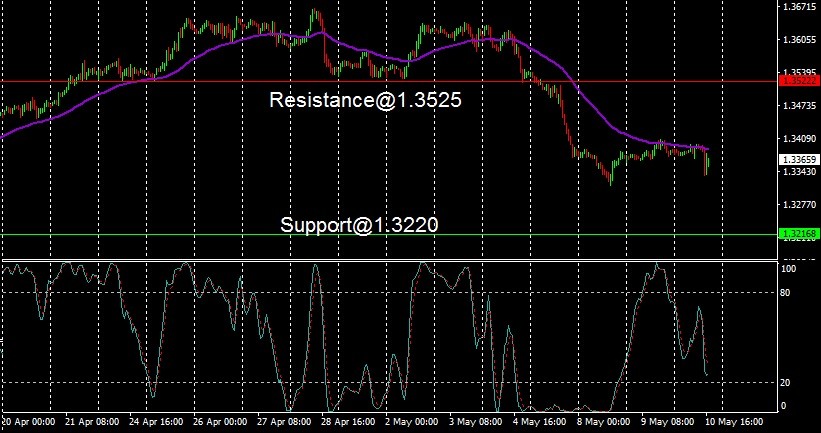
The greenback lost ground against the loonie yesterday following reports of overwhelmingly positive Canadian building permit data for March. The US dollar’s decline was also fueled by lower-than-expected annual consumer inflation for April. Market participants will be discouraged from making bullish bets on the US dollar as the Fed could temporarily halt the policy tightening process. Overall, the USD/CAD pair declined from a high of 1.3400 to a low of 1.3335 in the past 24 hours.
According to Statistics Canada, the country’s building permits rose by 11.30% m-o-m in March to C$11.80 billion from 5.50% in the previous month, which delighted economists who were expecting a 2.30% decline in the building permits.
The increase was primarily led by a 32% jump in non-residential building permits. Specifically, the total value of non-residential permits was C$5.20 billion. This includes 10 individual non-residential projects worth $100 million each. While commercial permits rose by 41.50%, institutional permits surged by 29.50%.
Fresh residential permits declined 0.90% to C$6.60 billion. Countrywide, permits for 21,400 fresh dwellings were issued in March.
The aggregate value of building permits grew by 4.80% q-o-q in the March 2023 quarter to C$32.40 billion, reflecting an end to three successive quarters of declines.
The quarterly growth was led by a 17.20% increase in commercial building permits. As a whole, the non-residential sector rose by 16.10% in the March 2023 quarter to C$13 billion, far higher than the earlier quarterly high of C$12.40 billion.
According to the Bureau of Labor Statistics, US consumer prices rose by 0.40% m-o-m in April, following an increase of 0.10% in the previous month and in line with economists’ expectations. The energy index increased by 0.60% in April. However, the food index stood unchanged during the same period. While the index for food at home declined 0.20% m-o-m in April, the index for food away from home inched up 0.40%.
On a y-o-y basis, US consumer prices rose by 4.90% in April 2023. In March, consumer prices grew by 5% year-on-year. The reported figure, reflecting the smallest yearly increase since April 2021, was a notch lower than forecasts of a 5% increase. The slightly weaker data will discourage the market from making bullish bets on the US dollar, as the Fed could temporarily halt the policy tightening process.
Excluding the food and energy index, the US core consumer price index increased 5.50% y-o-y in April 2023. The energy index fell by 5.10% y-o-y in April, while the food index rose by 7.70% in the same period.
The Bureau of Labor Statistics also stated that the core consumer price index, which excludes food and energy, inched up 0.40% m-o-m in April, following a similar increase in the previous month and a notch higher than 0.30% growth in the same period.
The upbeat Canada building permits data and lower-than-anticipated US annual inflation data are expected to keep the USD/CAD pair slightly weaker in the short term.
The historical price chart indicates that the USD/CAD pair is declining after facing resistance at 1.3525. The next support is anticipated only near 1.3220. Additionally, the USD/CAD pair is trading below its 50-day moving average, while the stochastic indicator is in the bearish zone. Therefore, we anticipate the currency pair to remain in a downtrend in the short term.
Disclaimer: Any financial trading analysis offered here is our opinion and is not intended as advice or direction for investors. We cannot guarantee the success of any trades made as a consequence of this article, and we encourage traders to incorporate a strong money management strategy to limit losses when they enter the markets. Please use this article as part of your own research before formulating strategies prior to trading.