
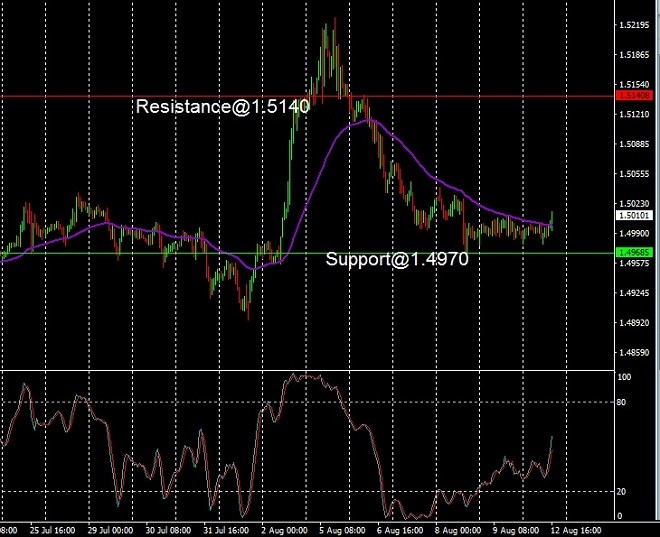
The Canadian dollar lost ground against the euro yesterday following the release of unexpectedly weak building permit data for June. The German wholesale price index data for July was better than estimates. There were no other major economic releases on the first trading day of the week. Overall, the EUR/CAD pair rallied from a low of 1.4970 to a high of 1.5011 in the past 24 hours.
As reported by Destatis, the German wholesale price index edged up 0.30% m-o-m in July following a 0.30% decline in the previous month, surpassing forecasts of 0.20% growth.
The wholesale prices of chemical products decreased by 0.40% m-o-m in July.
On a year-over-year basis, German wholesale selling prices fell 0.10% in July 2024. Notably, German wholesale prices fell by 0.60% y-o-y in June. The reported figure reflects the 15th successive monthly decrease in producer prices but at the softest rate in the series.
The drop was led by an 8.40% y-o-y drop in chemical product prices in July. Likewise, the wholesale prices of live animals plunged by 9.50% in the same period. Also, iron, steel, and ferrous semi-finished metal products recorded a decrease of 7.7%. Similarly, computers and peripheral equipment posted a dip of 5.5%.
On the contrary, wholesale prices of coffee, tea, cocoa, and spices surged 19.50% y-o-y in July 2024. Likewise, the wholesale prices of non-ferrous semi-finished metal products, non-ferrous metals, and non-ferrous ores surged by 15.40%. The wholesale prices of waste and scrap also increased by 15.20% year-over-year in July.
Additionally, sugar, confectionery, and bakery products saw a 9.50% rise year-over-year in July, while tobacco products experienced a 4.70% increase during the same period. According to Statistics Canada, the country’s cumulative value of building permits declined by 13.90% m-o-m in June to C$9.90 billion, following a decrease of 12.70% in the prior month. Economists had anticipated the building permits to increase by 5.60%.
Eleven out of 13 provinces and territories recorded a decline. Both residential and non-residential sectors recorded decreases.
The cumulative value of residential permits fell by 11.50% m-o-m in June to C$6.50 billion. Overall, nine out of 13 provinces and territories paved the way for the decrease in residential permits.
Canadian municipalities authorized 20,400 dwelling units in June 2024, taking the tally to 263,400 units since July 2023.
The cumulative value of non-residential sector permits fell by 18.10% in June to C$3.50 billion. The industrial component fell by 42.60% (or $447.20 million) in June, following a 21.30% rise in May. Commercial components plunged 15.60% (or C$331.10 million) in June. However, the institutional component rose by 1% (or C$11.10 million) in the same period.
The cumulative value of building permits was C$34.60 billion in the June 2024 quarter, an increase of 2.10% from C$33.90 billion in the first quarter. The reported figure reflects the second successive quarterly rise and the fourth-highest quarterly value in the series. Overall, across Canada, 70,200 residential units received permits in 2Q 2024, an increase of 9.10% in the March 2024 quarter.
The unexpectedly weak Canadian building permit data is expected to keep the EUR/CAD pair slightly bullish in the near term.
The historical price chart indicates that the EUR/CAD pair is rising after testing the support at 1.4970. The next resistance is anticipated to be only near 1.5140. Additionally, the currency pair is trading above its 50-day moving average, while the stochastic indicator is ascending toward the bullish zone. Therefore, we anticipate the EUR/CAD pair to remain in an uptrend for the upcoming trading sessions.
Disclaimer: Any financial trading analysis offered here is our opinion and is not intended as advice or direction for investors. We cannot guarantee the success of any trades made as a consequence of this article, and we encourage traders to incorporate a strong money management strategy to limit losses when they enter the markets. Please use this article as part of your own research before formulating strategies prior to trading.