The markets for iron ore spot markets rose yesterday, reaching new multi-year highs. The spot price for benchmark 62% fines increased 0.7% to $73.80 per ton and thus remained at the highest level since March the 7th of this year. The benchmark index has risen 16.9% since its recent low of USD 63.14 per ton on July the 5th.

However, the Aussie dollar has not shown any signs of bullishness. In fact, the outcome of the by-election, unfavorable geopolitical factors, ACTU (Australian Council of Trade Unions) campaign, and an overall decline in consumer spending is keeping the Aussie at multi-year lows.
Multiple factors keeping the Australian dollar under pressure
The Australian dollar is influenced by a number of factors. At first, the Australian government seemed on the way to losing its single-seat majority in parliament. The Australian Liberal Party lost its majority in the House of Representatives on Saturday when voters voted in favor of independent candidate Kerryn Phelps over David Sharma, the government’s man, in the Wentworth by-election. Wentworth has been free since the resignation of former Prime Minister Malcolm Turnbull after dethronement by a change of leadership in August.
At 10 pm yesterday, when coverage of the Wentworth election for the night ended, independent candidate Kerryn Phelps led 54% of the two candidates’ preferential election vote over liberal candidate Dave Sharma, and most political analysts had called the race for Phelps. On the assumption that the Liberal Party has lost its seat, the “coalition government will have to rely on the support of independents to govern until the federal elections in May 2019,” says Westpac currency strategist Sean Callov.
The result of Monday’s election came when the markets assessed the statements of White House economic adviser Larry Kudlow, who told in an interview that China had not reacted to a series of US authorities concerns about its “unfair trade practices,” which are at the core of the trade war between the two countries.
The markets also struggled due to President Donald Trump’s plan to pull back from the Intermediate-Range Nuclear Forces treaty with Russia that was intended to avoid the creation of certain nuclear weapons. Trump told a public meeting in Nevada over the weekend that he will pull back the USA from the treaty.
In other news, six days of industrial interference caused by ACTU’s “Change The Rules campaign” is anticipated to remove over $250 million in abandoned productivity and earnings from the nationwide economy. While a few union officials think protests in Sydney and Melbourne could draw up to 150,000 workers at every rally, industry sources say the total financial impact of the wasted work and productivity could tantamount to nearly 3000 full-time jobs.
Analysis by Masters Builders Australia, the main association representing builders and the construction industry, indicates the straightforward and roundabout expenses to the economy of the six-day campaign will be a maximum of $250m.
Spending levels across the Australian economy grew at the slowest pace in over a year in September, driven by a sharp reduction in expenditure among businesses.
The Commonwealth Bank’s Business Sales Indicator (BSI) — a measure that uses the value of credit and debit card transactions processed through Commonwealth Bank merchant facilities to track economy-wide spending — grew by just 0.2% in trend terms last month, the weakest increase seen since May 2017.
Coming to economic data, spending levels in the Australian economy grew the least in September throughout the year, reflecting a sharp fall in corporate spending. The Commonwealth Bank’s Business Sales Indicator (BSI) grew by just 0.2% last month, the weakest increase seen since May 2017. All the factors discussed above are keeping the Australian dollar bearish.
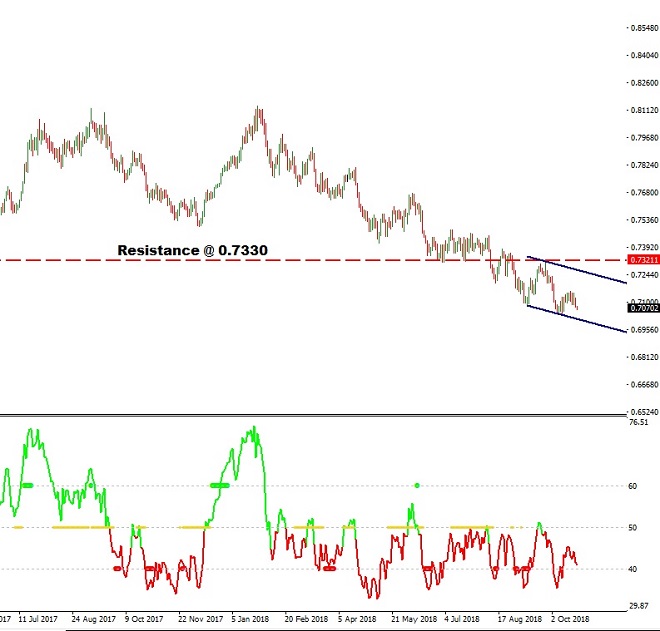
Technically, the AUDUSD pair has broken the major support at 0.7330. The currency pair is also moving along the descending channel. Additionally, the RSI indicator is moving in the bearish zone. As a result, we can expect the AUDUSD pair to move down further.
Disclaimer: Any financial trading analysis offered here is our opinion and is not intended as advice or direction for investors. We cannot guarantee the success of any trades made as a consequence of this article, and we encourage traders to incorporate a strong money management strategy to limit losses when they enter the markets. Please use this article as part of your own research before formulating strategies prior to trading.