The Bank of Russia slashed the benchmark interest rate in line with the previous guidance, the third rate cut in as many policy meetings, and hinted further easing as economic growth remains sluggish and inflation remains weak. However, the greenback was unable to gain ground against the ruble as the US Labor Department reported lower-than-anticipated job additions in August. From a high of 66.23, the USD/RUB declined to a low of 65.58 in the past 24 hours.
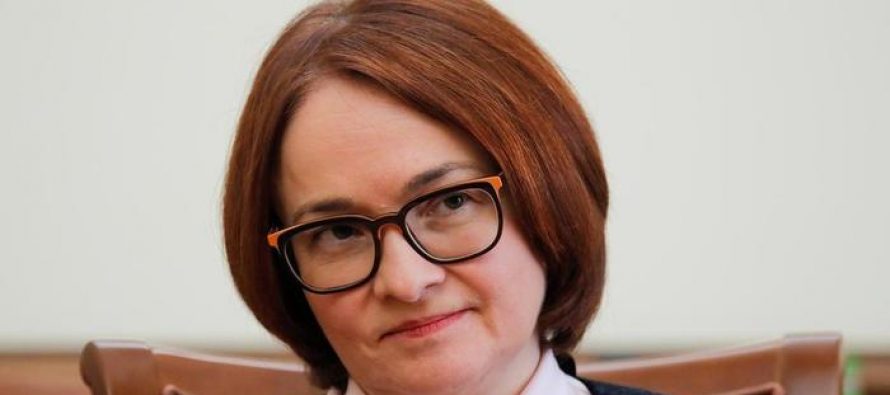
In an attempt to boost economic growth and increase inflationary pressure, the Bank of Russia decided to slash the interest rate by 25 basis points to 7%. The decision was taken by the Board of Directors, led by Governor Elvira Nabiullina. The Governor, however, declined to reveal whether the next rate cut would be in the October or December meeting.
Nabiullina simply said, “A lowering of the key rate is likely at one of the upcoming meetings.”
The central bank previously slashed interest rates by 25 basis points in June and July and the reduction of 25 basis points in June was the first of its kind since March 2018. Since the announcement of the previous rate cut decision on July 26th, the ruble has lost 4% against the greenback.
The bank pointed out that inflation is slowing, while expectations remain high. Headline inflation has declined to 4.3% in August, from 4.6% earlier the month. Core inflation fell to 4.3%, from 4.5%.
Weak external demand due to the overall global economic slowdown has caused a drop in Russian exports. The domestic economy is also affected by a downturn in investment activities, including government expenditures.
Regarding risks to the economy, Nabiullina said, “An important external factor is a slowdown in growth of the global economy, which has proven more tangible than expected due to, among other things, the growing contradictions in international trade.”
Considering the economic slowdown, the central bank slashed its GDP growth outlook for 2019 to a range of 0.8% to 1.3%, from 1% to 1.5%. The outlook for 2020 was also lowered. The pace of growth might increase to 2% to 3% by 2022.
The Bank of Russia also cut its annual inflation outlook for 2019 to a range of 4% to 4.5%, from 4.2% to 4.7%. The bank stated that considerable risks prevail because of high inflation expectations.
The Bank of Russia said, “If the situation develops in line with the baseline forecast, the Bank of Russia will consider the necessity of further key rate reduction at one of the upcoming Board of Directors’ meetings.”
Alexander Isakov, an economist at VTB Capital expects two more rate cuts before the end of the first quarter of 2020. Isakov said: “We expect the key rate to be lowered to 6.75% in December and to 6.5% by the end of the first quarter of 2020.”
Economy Minister Maxim Oreshkin has suggested further easing to boost growth, which dropped to 0.7% in the first half of 2019. Oreshkin has cautioned that inflation could decline to a low of 3% at the beginning of 2020.
The next policy meeting is scheduled for October 25th.
In the US, the non-farm sector added 130,000 jobs in August, after adding a downwardly revised 159,000 jobs in the earlier month. Economists had anticipated the non-farm sector to add 158,000 jobs in the reported month. The previous estimates indicated that the non-farm sector added 164,000 jobs in July.
Notably, a rise in healthcare and financial services-related employment was partially offset by the loss of jobs in the retail and mining sector. In the meantime, the Labor Department stated that the unemployment rate stood at 3.7% in August, unchanged from the previous month and in line with economists’ estimates.
Commenting on the job data, ING Chief International Economist James Knightley said, “Payrolls growth is slowing, but wages are picking up, which underlines the difficult decision facing the Federal Reserve. The risks from a deteriorating international backdrop and a manufacturing recession mean we still look for September and December rate cuts.”
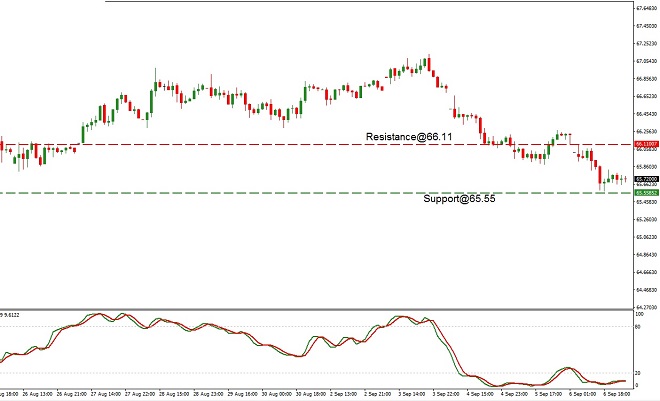
Technically, the USD/RUB pair has found support at 65.55. The stochastic oscillator is in the oversold region. As a result, we can expect the currency pair to move up in the short-term.
Disclaimer: Any financial trading analysis offered here is our opinion and is not intended as advice or direction for investors. We cannot guarantee the success of any trades made as a consequence of this article, and we encourage traders to incorporate a strong money management strategy to limit losses when they enter the markets. Please use this article as part of your own research before formulating strategies prior to trading.