

The Australian dollar rallied against the Canadian dollar in the Asian session yesterday following the overwhelmingly positive retail sales data report by the Australian Bureau of Statistics. In the US session, Statistics Canada reported a slightly lower consumer price index data.
However, the Bank of Canada’s decision to maintain interest rate affirmation keeps the interest rates unchanged until all the economic shocks related to COVID-19 disappear, an upward revision of GDP growth outlook, and reduction in bond buying per week enabled the Loonie to regain the rally against the Aussie.
According to the Australian Bureau of Statistics, retail sales increased 1.4% m-o-m in March, following a decline of 0.8% in the earlier month and more significant than the 1% growth anticipated by economists. In value terms, retail sales increased by $423.90 million in March.
On a y-o-y basis, retail sales increased 2.3% in March 2021. In February 2021, the retail sales increased 9.1% on a y-o-y basis. The decline mirrors the enforcement of COVID-19 prohibitions in March. Notably, the retail sales in March quarter 2021 were almost unaltered compared to the earlier quarter.
The increase was led by Western Australia (5.5%) and Victoria (4%). Industry-wise, cafes, restaurants, and takeaway food services recorded a 6% increase. Likewise, clothing, footwear, and department stores also recorded an increase. Food retailing, on the contrary, posted a 1% decrease.
In price-adjusted terms, retail sales declined 0.1% q-o-q in the March quarter.
Statistics Canada stated that in the US session, the consumer price index increased by 0.5% m-o-m in March, unaltered from the earlier month, but missed the 0.6% growth anticipated by economists.
On a y-o-y basis, the consumer price index increased 2.2% in March, following a rise of 1.1% in the prior month. Last month, prices increased in five of the eight sectors on a y-o-y basis.
Specifically, transportation and shelter recorded a rise of 7.1% and 2.4%, respectively. On a y-o-y basis, the price of clothing and footwear decreased 5.4% in March 2021. Likewise, household operations, furnishings, and equipment posted a drop of 0.2%.
The increase in consumer energy prices was led by gasoline prices, which increased 35.3% y-o-y in March. Notably, it is the most significant increase in gasoline prices since March 2000.
Prices for natural gas increased 14.1% y-o-y in March. Also, fuel oil and other fuels posted an increase of 7.7%. Shelter prices increased 2.4% on a y-o-y basis in March. As the price of building materials and demand for single-family homes continued to rise, the homeowners’ replacement cost index, associated with new home prices, rose by 7.9% y-o-y.
An index reflecting the price of food purchased from stores increased 1.3% y-o-y in March 2021, unchanged from February. On a y-o-y basis, the price of eggs rose 11.4% in March 2021.
Likewise, dairy products posted a rise of 2.4%. On the contrary, beef prices declined 2.1% y-o-y in March, following a 0.3% rise in February. The decline was primarily due to an increase in supply.
Following the monetary policy meeting, the Bank of Canada decided to maintain the interest rates unchanged at 0.25%. It affirmed that it will not raise the benchmark rates until the economy returns to its original form (pre-COVID-19 levels) and also shocks related to the pandemic fades away.
Considering the strong economic rebound, the central bank also decided to reduce bond-buying to C$3 billion per week. In its policy report, the Bank of Canada also stated that the inflationary pressure would hit the high end of the target range (2%) temporarily. The central bank also upwardly revised its GDP growth target to 6.5% in 2021, 3.7% in 2022, and 3.2% in 2023. As a note of caution, the bank stated that the economy still requires ample support for recovery.
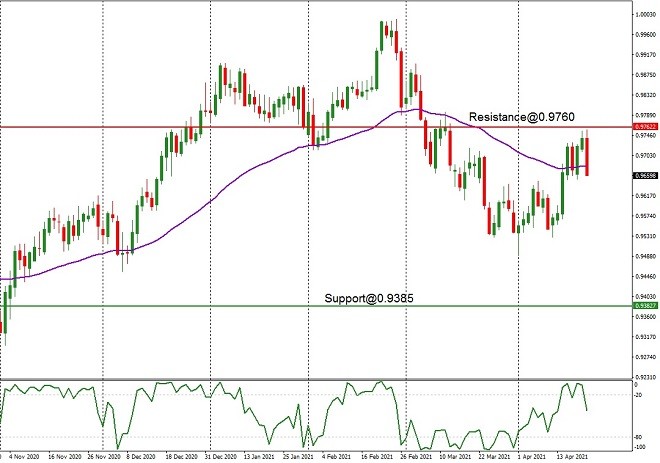
The positive monetary policy report published by the Bank of Canada is expected to keep the AUD/CAD pair range-bound with a slight bearish bias.
The price chart provided underneath indicates that the AUD/CAD pair struggles to cross above the resistance level of 0.9760. The next significant support is anticipated only near 0.9385. Additionally, the Williams’ percentage range indicator is declining towards the bearish zone. Therefore, we are anticipating the currency pair to decline further in the days ahead.
Disclaimer: Any financial trading analysis offered here is our opinion and is not intended as advice or direction for investors. We cannot guarantee the success of any trades made as a consequence of this article, and we encourage traders to incorporate a strong money management strategy to limit losses when they enter the markets. Please use this article as part of your own research before formulating strategies prior to trading.


