
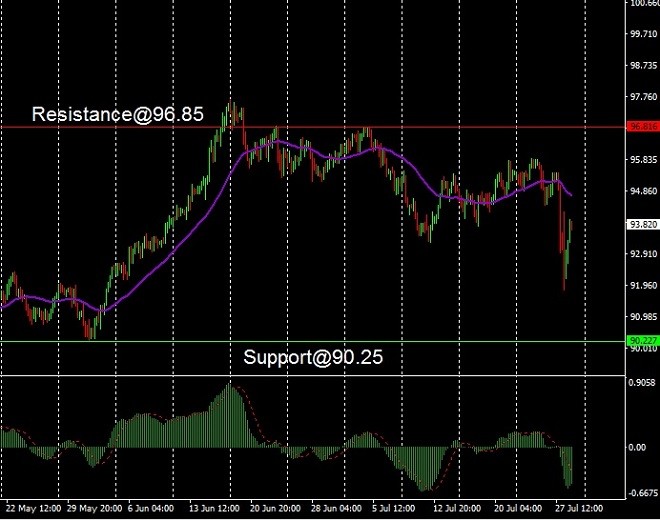
The Aussie fell against the yen on Friday following reports of unexpectedly weak June retail sales data. The Bank of Japan’s decision to widen the bond yield tolerance by another 50 bps (+/-) also fueled interest in the yen. Overall, the AUD/JPY pair declined from a high of 95.85 to a low of 91.80 in the past 24 hours.
According to Japan’s Statistics Bureau, the Tokyo consumer index rose by 3% y-o-y in July following a 3.20% rise in the previous month and greater than the 2.90% growth anticipated by economists. The decline from May was due to a drop in energy prices, as per the Ministry of Internal Affairs. Excluding energy, the core CPI surged to a four-decade high of 4%.
The data indicates that there is a likelihood of a further increase in inflationary pressure, raising doubts about BoJ’s governor Ueda’s perspective that inflation will decrease during the latter half of this fiscal year. Since assuming the position of governor in April, the chief has consistently voiced doubts regarding the long-term viability of the latest price rises. This stance serves as a countermeasure against speculations suggesting an imminent shift in the course of monetary policy.
At the end of its two-day monetary policy meeting, the Bank of Japan left its short-term interest rate unchanged at -0.10%. The central bank also lifted its inflation forecast to 2.50% for fiscal 2023 following its July meeting, an increase from 1.80% in April. Additionally, the BoJ also downwardly amended its inflation forecast for 2024 to 1.90% from its earlier guidance level, while maintaining its 2025 forecast of 1.60%.
In a significant development, the central bank of the world’s third-largest economy has committed to increasing flexibility over its yield curve control strategy. Specifically, the Bank of Japan has announced its intention to conduct fixed-rate activities, by offering to buy 10-year Japanese Government Bonds (JGBs) at an interest rate of 1% on any given day of business. This initiative will be implemented except when no bids are presented. The decision effectively increases the Bank’s degree of tolerance by an additional 50 basis points.
The BoJ’s policy statement reveals its intention to maintain a flexible approach toward the 10-year Japanese Government Bond (JGB) yields, allowing them to vary within a range of approximately plus or minus 0.50% from the predetermined target level.
According to the Australian Bureau of Statistics, the country’s producer price index inched up 0.50% q-o-q in the June 2023 quarter following a 1% rise in the March 2023 quarter and was lower than forecasts of 0.90% growth.
On a y-o-y basis, Australia’s PPI surged 3.90% in June 2023.
The increase was led by a 0.90% rise in building construction. Also, heavy and civil engineering construction inched up 0.80%. Cafes, restaurants, and takeaway food services increased by 1.70%.
This was offset by a 10.70% decline in accommodation. Additionally, motor vehicle and motor vehicle part manufacturing fell by 2.8%. Petroleum refining and petroleum fuel manufacturing declined by 4.20%.
According to the Australian Bureau of Statistics, the country’s retail sales fell by 0.80% m-o-m in June, following a 0.80% increase in the previous month. Economists anticipated a flat reading for the reported period.
On a y-o-y basis, the country’s retail sales rose by 2.30% in June 2023.
The reported figure reflects the second decline in retail sales in 2023 as an increase in cost-of-living expenses continued to have an impact on consumer spending. Department stores recorded a 5% decline in retail sales. Additionally, retailing fell by 2.20% m-o-m in June. Clothing and footwear posted a decrease of 2.20%. Notably, for the eighth month in a row, household goods retailing inched lower by 0.10%.
The weak Australian retail sales data and the BoJ’s decision on bond yield tolerance are expected to keep the AUD/JPY pair range-bound in the short term.
The historical price chart indicates that the AUD/JPY pair is declining after facing resistance at 96.85. The next support is anticipated only near 90.25. Additionally, the currency pair is trading below its 50-day moving average, while the MACD indicator is showing a negative reading. Therefore, we anticipate the AUD/JPY pair to remain in a downtrend in the short term.
Disclaimer: Any financial trading analysis offered here is our opinion and is not intended as advice or direction for investors. We cannot guarantee the success of any trades made as a consequence of this article, and we encourage traders to incorporate a strong money management strategy to limit losses when they enter the markets. Please use this article as part of your own research before formulating strategies prior to trading.