The upbeat Australian employment change data enabled the Aussie to gain ground against the euro yesterday. The weak Eurozone industrial production data for April also enabled the Aussie to cement its gains. Overall, the EUR/AUD pair declined from a high of 1.6273 to a low of 1.6190 in the past 24 hours.
According to the data published by the Australian Bureau of Statistics, the country’s economy added 39,700 jobs in May, following 37,400 jobs in the previous month, surpassing forecasts of 30,500.
Including the above additions, the number of employed people rose to 14,355,600 in May from 14,316,000 in April. Consequently, the number of unemployed people fell to 598,900 in May from 608,100 in the prior month.
The participation rate remained unchanged at 66.80% in May compared to the previous month. Likewise, the underemployment rate and employment-to-population ratio remained unaltered at 6.70% and 64.10%, respectively.
However, the monthly hours worked fell to 1,951 million in May from 1,960 million in April.
Full-time employment grew by 41,700 to 9,899,900 people. On the contrary, part-time employment fell by 2,100 to 4,455,700 people.
Overall, Australia’s unemployment rate inched down to 4% in May from 4.10% in April and met the market’s expectations.
According to Destatis, the German wholesale price index inched up 0.10% m-o-m in May after a 0.40% increase in the previous month, missing forecasts of 0.30% growth.
On a y-o-y basis, German wholesale selling prices fell by 0.70% in May 2024. The year-on-year decline was led by a 13.90% fall in the wholesale prices of chemical products. On an m-o-m basis, these prices decreased by 0.90%.
Similarly, the wholesale prices of iron, steel, and ferrous semi-finished metal products dipped 12.10% y-o-y in May. On an m-o-m basis, prices declined 0.50% in May.
On the contrary, the wholesale prices of non-ferrous ores, non-ferrous metals, and non-ferrous semi-finished metal products surged 9.70% y-o-y in May 2024. Also, coffee, tea, cocoa, and spice prices jumped 8.2% in the same period.
The Eurozone industrial production inched down 0.10% m-o-m in April, following a 0.50% growth in the previous month, missing forecasts of a 0.10% increase.
The decrease was led by a 0.40% drop in the production of intermediate goods. Energy production rose by 0.40% m-o-m in April. Likewise, capital goods recorded an increase of 0.70%. Durable consumer goods and non-durable consumer goods posted growth of 0.30% and 3.40%, respectively.
On a y-o-y basis, Eurozone industrial production fell by 3% in April 2024. The decrease was led by a 5.30% decline in the production of capital goods. Intermediate goods posted a fall of 2%. Energy and durable consumer goods recorded a decrease of 1.10% and 3.10%, respectively. Non-durable consumer goods inched up 0.70% in the same period.
The upbeat Australian employment change data is expected to keep the EUR/AUD pair slightly bearish in the near term.
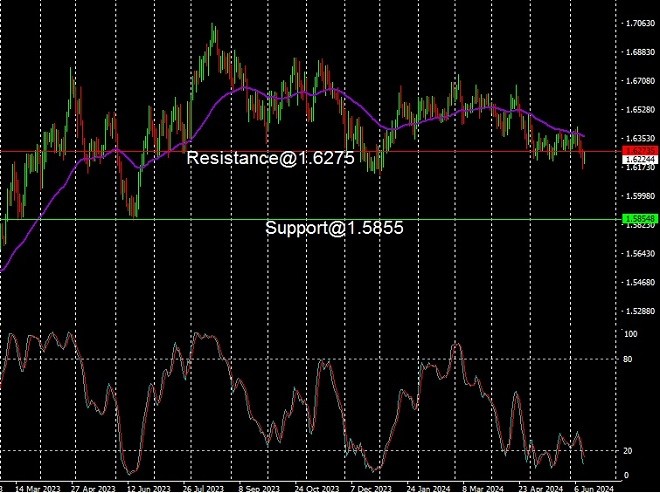
The historical price chart indicates that the EUR/AUD pair is descending after facing resistance at 1.6275. The next major support is anticipated to be only near 1.5855. Additionally, the currency pair is trading below its 50-day moving average, while the stochastic indicator is in the bearish zone. Therefore, we anticipate the EUR/AUD pair to remain in a downtrend for the next few trading sessions.
Disclaimer: Any financial trading analysis offered here is our opinion and is not intended as advice or direction for investors. We cannot guarantee the success of any trades made as a consequence of this article, and we encourage traders to incorporate a strong money management strategy to limit losses when they enter the markets. Please use this article as part of your own research before formulating strategies prior to trading.