
The Aussie gained ground against the euro yesterday following the release of upbeat inflation data for the December quarter. Notably, the ifo German business climate index also met economists’ expectations. However, the current situation index has further declined in January. This enabled the Aussie to gain ground against the euro. Overall, the EUR/AUD pair declined from a high of 1.5480 to a low of 1.5308 in the past 24 hours.
According to the data published by the Australian Bureau of Statistics, the country’s consumer price index grew by 1.90% q-o-q in the December 2022 quarter, following a 1.80% rise in the earlier quarter and pleasing economists who were expecting a 1.60% increase for the reported period.
On a y-o-y basis, the CPI surged 7.80% in the December 2022 quarter. The reported figure is the highest since 1990. Furthermore, trimmed mean annual inflation, which does not include large increases and decreases in prices, rose to 6.90%, the highest level since the statistical institution initially published the series in 2003.
The increase was led by a 13.30% rise in domestic holiday travel and accommodation in the December 2022 quarter. Electricity grew by 8.60% in the same quarter. Also, international holiday travel and accommodation rose by 7.6%. Overall, new dwelling purchases by owner-occupants inched up 1.70%.
Notably, service inflation was 5.5% y-o-y in the December 2022 quarter, reflecting the highest level since 2008. The increase was led by holiday travel and meals out and takeaway food.
Automotive fuel prices grew by 2.20% in the December 2022 quarter. Discretionary inflation increased by 2.60% in the same period.
According to the data published by the ifo Institute, the German business climate index increased to 90.20 in January, from 88.60 in December, in line with economists’ estimates. The reported reading reflects the fourth successive monthly increase and is also the highest figure since June 2022.
The European economic powerhouse has begun the year with cautiously positive sentiment against the backdrop of easing inflationary pressure and a slightly improved economic outlook as pressure on distribution chains softened.
The expectations index improved to 86.40 in January, from 83.20 in December. However, the current situation index inched lower to 94.10 from 94.40. Manufacturers’ sentiment improved to -0.70, from -5.70. Likewise, service providers’ sentiment rebounded, with the corresponding index rising to 0.20 from -1.20. Also, traders’ and contractors’ sentiments improved to -15.40 and -21.60, respectively.
Furthermore, the ifo institute anticipates a slight contraction of the economy in the first quarter, primarily due to a drop in consumption, but a recession will likely be avoided.
The upbeat Australian CPI data is expected to keep the Aussie slightly bullish against the euro in the days ahead.
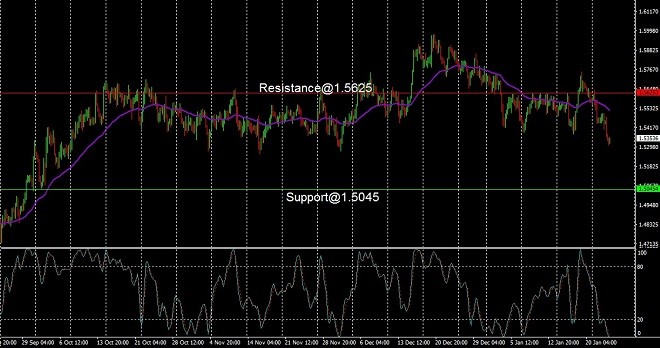
The historical price chart indicates that the EUR/AUD pair is declining after failing to stay above the support at 1.5625. The next support is anticipated only near 1.5045. Additionally, the EUR/AUD pair is trading below its 50-day moving average while the stochastic indicator is in the bearish zone. Therefore, we anticipate the EUR/AUD pair to remain in a downtrend in the near term.
Disclaimer: Any financial trading analysis offered here is our opinion and is not intended as advice or direction for investors. We cannot guarantee the success of any trades made as a consequence of this article, and we encourage traders to incorporate a strong money management strategy to limit losses when they enter the markets. Please use this article as part of your own research before formulating strategies prior to trading.