The Australian dollar fell on Thursday against the greenback and other G10 rival currencies after the RBA (Reserve Bank of Australia) reported weaker-than-expected inflation data. During the third quarter, core inflation rose an average of 1.75% compared with 1.9% in the previous quarter.
On an annualized basis, the headline consumer price index increased 1.9% for the year, in-line with analysts’ estimates, but lower than the 2.1% pace recorded in the second quarter. The data implies that the monetary policy would remain accommodative for a long time. Notably, the RBA has maintained the benchmark interest rates at an all-time low of 1.5% since August 2016.
Trade surplus and commodity prices push the Aussie upwards
Earlier today, the Australian Bureau of Statistics (ABS) reported an increase in the country’s trade surplus to $3.02 billion in September, far better than economists’ expectation of $1.70 billion. Including this, the overall surplus in the third quarter is $6.40 billion, almost thrice the second-quarter surplus of $2.20 billion.
Commenting on the trade surplus, David de Garis, a Melbourne-based economist at National Australia Bank, said “Net export volumes likely contributed around 0.2 percentage points to growth” in the third quarter.”
Following the release of strong trade surplus figures, the Australian dollar is inching higher against the greenback. At the time of preparing this report, the Aussie has covered all the losses from the previous session to trade at $0.7120 levels.
The Aussie is also rising due to optimism about a possible solution to the China-US trade issue. A rebound in Chinese stocks on news of several steps taken by the Chinese government to support the economy also turned the Aussie bullish.
The Chinese government’s support of the economy has considerably increased the demand for iron ore, whose prices have gone up to $76.20 per ton from about $64 per ton last month. Australia is the largest supplier of iron ore to China, which consumes almost half of the world’s iron ore. In general, the construction sector is the first who have shown a positive reaction to the government lending support to the economy.
Natural gas, which is Australia’s second-largest export commodity, is also expected to see a rally this winter, even though US production remains at record highs. The US inventories have not seen a surge in stockpiles in the past six months. Furthermore, inventories replenished at a much slower rate than anticipated. As a result, natural gas inventories are at their lowest level in 15 years.
For the week ending October 19, the US natural gas inventories stood at 3,095 billion cubic feet (bcf), down 606 bcf from the same period last year. Therefore a rally in natural gas prices is expected.
Commenting on the natural gas prices, BofAML (Bank of America Merrill Lynch) said: “A cold winter paired with higher coal prices and reduced gas-to-coal switching could propel NYMEX natural gas to a brief spike over $5.00/MMBtu.”
The factors mentioned above aid the strengthening of the Aussie against the greenback.
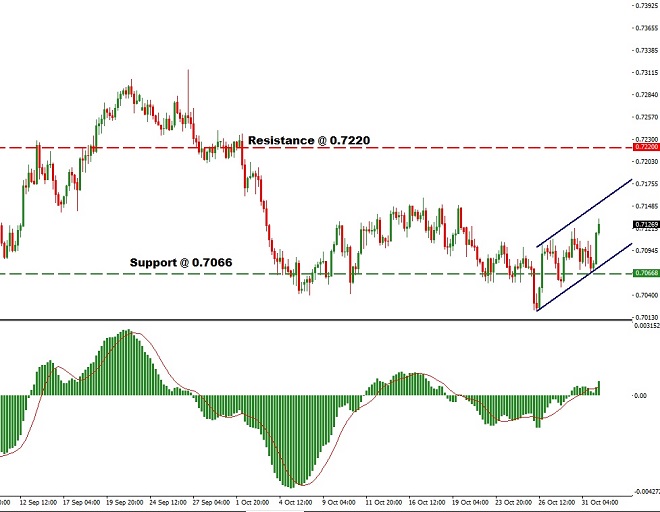
Technically, the AUDUSD pair has found support at 0.7080 levels. The currency pair is also moving along the ascending channel. The MACD indicator has also crossed into the positive region. Therefore, we can expect the currency pair to move up in the short-term.
Disclaimer: Any financial trading analysis offered here is our opinion and is not intended as advice or direction for investors. We cannot guarantee the success of any trades made as a consequence of this article, and we encourage traders to incorporate a strong money management strategy to limit losses when they enter the markets. Please use this article as part of your own research before formulating strategies prior to trading.