The Canadian dollar remained slightly bullish against the greenback on the first trading day of the week as investors continued to track developments related to the Bank of Canada and the US Fed’s monetary policy. The market participants increased their bets on further rate hikes by the BoC as inflationary pressures continued to remain high. There were no major economic releases on Monday. Overall, the USD/CAD pair declined from a high of 1.3615 to a low of 1.3580 in the past 24 hours.
Canada’s annual inflation rate increased to 4.40% in April from 4.30% (a 19-month low) in March and was higher than forecasts of 4.10%. The reading, reflecting the first increase in inflation after 10 successive months of decline, has kindled discussions about the resumption of interest rate hikes by the Bank of Canada.
Consumer prices jumped as the policy tightening by the central bank resulted in higher mortgage rates and rental prices. Consumer prices also increased by 1.30% for transportation. On the contrary, inflation declined by 8.30% for food. On a m-o-m basis, Canada’s CPI rose by 0.70%, the highest level in six months.
Considering the prevailing market conditions, as per Jean-François Perrault, chief economist and senior vice president at Scotiabank, a further rate hike of 25 basis points by the Bank of Canada is necessary to contain inflation.
Interestingly, wholesale sales in the country grew by 1.60% m-o-m in April, following a 0.10% decline in March. The increase primarily mirrored an 8% rise in the sales of petroleum, petroleum products, and other hydrocarbons and a 7.10% increase in motor vehicles and motor vehicle parts and accessories.
On the contrary, sales plunged by 11.90% for farm products. Machinery, equipment, and supplies recorded a decline of 1.70%. Additionally, personal and household goods posted a drop of 1.30%. Food, beverage, and tobacco products reported a decrease of 1.20%.
In the US, statements made by some Fed officials have increased anticipation of further rate hikes. In particular, James Bullard, president of the Federal Reserve Bank of St. Louis and a well-known supporter of rate hikes, has advocated another 50bps rate hike this year. In fact, Bullard has stated that he would support a rate hike at the June policy meeting.
Another 25bps rise would take the Fed funds rate to a target range of 5.25% to 5.50%, higher than the government officials’ estimate made in March for containing inflation.
Bullard also revealed that he does not anticipate disinflation, but the reason behind supporting another rate hike is that the decrease in inflationary pressure is slower than what he prefers.
The anticipation of rate hikes in both countries is expected to keep the USD/CAD pair range bound in the short term.
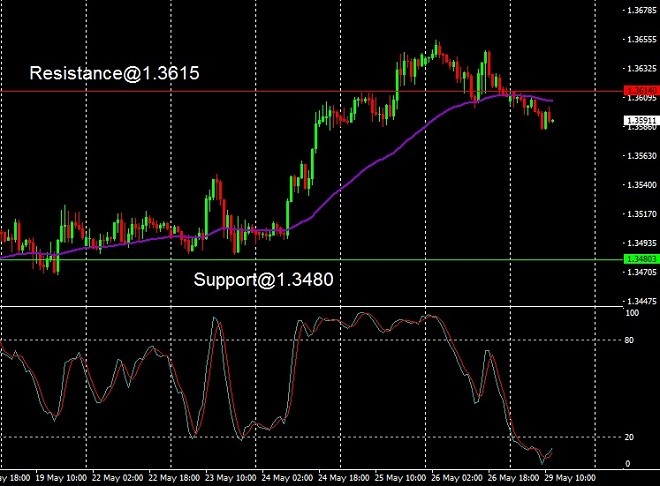
The historical price chart indicates that the USD/CAD pair is declining after facing resistance at 1.3615. The next support is anticipated only near 1.3480. Additionally, the USD/CAD pair is trading below its 50-day moving average while the stochastic indicator is in the bearish zone. Therefore, we anticipate the currency pair to remain in a downtrend in the short term.
Disclaimer: Any financial trading analysis offered here is our opinion and is not intended as advice or direction for investors. We cannot guarantee the success of any trades made as a consequence of this article, and we encourage traders to incorporate a strong money management strategy to limit losses when they enter the markets. Please use this article as part of your own research before formulating strategies prior to trading.