Deutsche Bank Aktiengesellschaft (NYSE: DB) reported a decline in pre-tax profit in the first quarter of fiscal 2019. Net profit, however, was higher compared to last year, mainly due to lower tax expenses. The German banking major, which called off merger talks with relatively smaller Commerzbank AG on Thursday last week, slashed its fiscal 2019 revenue view.
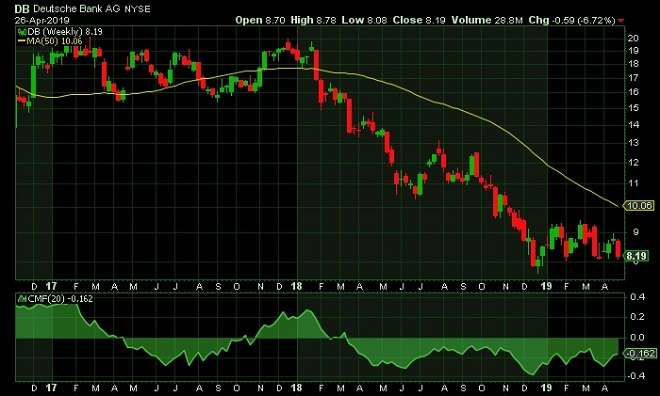
Following the unimpressive results and termination of merger talks, the stock closed at $8.19, down 1.92% from the prior close.
Net revenues for the quarter dropped 9% to €6.35 billion from €6.98 billion euros last year. Net revenues were down 5% when adjusted for specific items. The bank revealed that revenues from fixed income sales and trading declined 19% to €1.5 billion. Similarly, revenues from equity sales and trading dropped 18% to €468 million.
Frankfurt, Germany based Deutsche bank reported a 32% decline in the 1Q19 profit before income tax to €292 million, from €432 million in the corresponding quarter of fiscal 2018. The decline was mainly due to bank levy fees of €604 million for fiscal 2019 that were recorded in the quarter ended March 2019.
Group net income of the country’s biggest lender soared 67% to €201 million, from €120 million euros in the year-ago period.
Christian Sewing, Chief Executive Officer, said, “We have made progress on key business drivers: growth in loans and deposits, a recovery in assets under management, and market share improvements in corporate finance. Our continued cost discipline helped us to offset lower revenues and we are well on track to meet our 2019 cost target of 21.8 billion euros.”
Segment-wise:
- Corporate & Investment Bank revenues (CIB) declined 13% y-o-y to €3.33 billion. The decline was due to lower revenues in sales & Trading (Equity & Fixed Income), in addition to a fall in Origination & Advisory revenues.
- Private & Commercial Bank (PCB) revenues fell 5% to €2.51 billion. The decline was the outcome of lower revenues from operations within and outside Germany.
- Asset Management revenues declined 4% to €525 million, primarily due to lower management fees.
Provision for credit losses was €140 million euros, an increase of 60% on a y-o-y basis.
The bank’s common equity tier-1 ratio, a measure of a bank’s financial strength, stood at 13.7% at the end of 1Q 2019. In the year-ago period, the CET1 ratio was 13.4%.
Following the termination of merger talks with Commerzbank, Deutsche Bank said that it expects revenues to be flat in FY 2019. Notably, in March, Deutsche Bank had forecast a small increase in 2019 revenues.
Total non-interest expenses dropped 8% to €5.92 billion. Adjusted costs declined 7% to considerably negate a harsh business environment.
The mixed 1Q 2019 results and downwardly revised FY 2019 revenue outlook is expected to keep the stock bearish in the short-term.
The price chart indicates that the stock is trading below its 50-day moving average. Additionally, the Chaikin money flow indicator is in the negative region. As a result, we can expect the stock to move down in the short-term.
Disclaimer: Any financial trading analysis offered here is our opinion and is not intended as advice or direction for investors. We cannot guarantee the success of any trades made as a consequence of this article, and we encourage traders to incorporate a strong money management strategy to limit losses when they enter the markets. Please use this article as part of your own research before formulating strategies prior to trading.