The cryptocurrency market remains range-bound, with Bitcoin (BTC) trading between $61,000 and $67,000. While preparing this report, Bitcoin was trading at $66,537, up 0.90% in the past 24 hours. Ethereum (ETH) had lost 0.30% to trade at $3,184. XRP had gained 2.80% to trade at $0.5493.
Major cryptocurrencies that have gained ground in the past 24 hours are Binance Coin (BNB – $602.74, 1.20%), Polygon (MATIC – $0.7345, 0.30%), Polkadot (DOT, $7.41, 1.40%), Cardano (ADA, $0.511, 0.40%), Solana (SOL, $155.85, 3.30%), and Avalanche (Avax- $38.99, 1.90%).
Major cryptocurrencies that have lost ground in the past 24 hours are Shiba Inu (SHIB, $0.0000265, -2%), ChainLink (LINK – $15.47, -2.80%), and VeChain (VET, $0.0422, -0.40%).
Government Level Initiatives
Reserve Bank of India Expands CBDC Trial with Non-Bank Payment Processors
The Reserve Bank of India is taking the CBDC trial forward by including non-bank payment processors in the list of digital rupee wallet providers, which have been banks until now. The information was revealed by the RBI Governor, Shri Shaktikanta Das.
Furthermore, the RBI’s Deputy Governor, Rabi Sankar, provided an update on transaction volume. Sankar stated that enabling interoperability with UPI (Universal Payment Interface), India’s real-time payment app, has paved the way for reaching the target of one million transactions per day.
The cumulative transactions have exceeded 22 million since the beginning of the trial in December 2022. Currently, 4.60 million consumers and four hundred merchants are using the CBDC solution. However, most of the transactions are limited to a p2p basis, as only a small number of merchants are accepting the digital currency.
To foster usage, the central bank is adding new features. The central bank is in the process of facilitating programmable payments and offline functionality. The first programmable payments began last week, with a farmer receiving funds that could only be used for agriculture-related payments. Offline usage is currently undergoing trial.
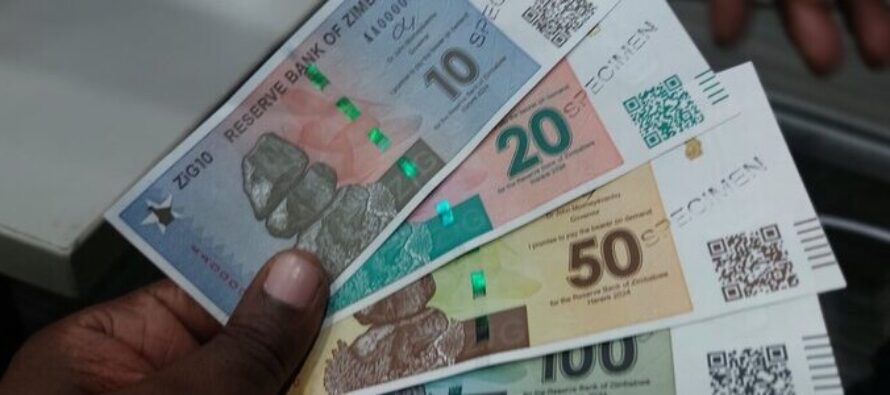
Zimbabwe Legalizes ZiG as New Currency, Backed by Gold Reserves
Zimbabwe, which minted gold-backed digital tokens named ZiG, has given it legal tender status. Currently, the Reserve Bank of Zimbabwe is taking initiatives to make ZiG the domestic currency and eventually replace the Zimbabwean dollar (Zim). Notably, the Zim faced inflationary pressure of over 50% in March.
Furthermore, the initially minted ZiG tokens have been rechristened as gold-backed digital tokens (GBDT). Until now, the Reserve Bank of Zimbabwe has issued 917 kilograms worth GBDT, valued at $69 million. The latest currency is a physical one.
The central bank intends to partially support the newly introduced ZiG currency with gold reserves, albeit not exclusively. As per the central bank’s statement, “the forthcoming currency framework is underpinned by a diversified pool of foreign currency and precious metals, predominantly gold, safeguarded as reserves by the Reserve Bank.”
Consequently, the forthcoming ZiG currency will be fully underwritten by the central bank’s reserves, totaling $100 million in foreign currency and $185 million in gold at present. Banks are required to transition Zim dollar accounts into ZiG accounts, with the issuance of new ZiG notes scheduled for circulation commencing April 30th.
Private Sector Initiatives
PayPal Integrates PYUSD Stablecoin with Xoom for Fee-Free Settlements
PayPal has integrated its PYUSD stablecoin with the Xoom cross-border payment solution. The US clients can use the stablecoin as a mode of settlement without incurring any fees. Nevertheless, if the settlement is done in a different currency for the payee, the transaction will be subject to normal currency conversion rates.
The stablecoin unveiled by PayPal in August 2023 currently commands a market cap of $190 million. While launching the stablecoin, da Ponte admitted that the initial application scenario would probably be related to Web3. Nevertheless, he voiced enthusiasm for employing them for cross-border payments, micropayments, and gaming.
Currently, companies in the DeFi domain retain a considerable percentage of the PYUSD balance. For instance, the top three wallets account for 49% of the stablecoin’s balance and are associated with Frax Finance, Curv, and Defiance Capital. Notably, both Frax and Curv are DeFi protocols.
Digimarc and DataTrails Collaborate Against Deepfakes with Tamper-Proof Audit Trails
For over a year, social media has been flooded with fake videos featuring prominent figures delivering speeches they never actually gave. As the US election gets closer, there’s growing fear regarding the potential use of AI to influence its outcome. Previously, metadata embedded in images or videos served as sufficient verification. However, the prevalence of content stripping on social media platforms has rendered this method ineffective.
To fight such challenges, Digimarc and DataTrails have joined forces to establish tamper-proof audit trails on distributed ledgers, ensuring authenticity. Utilizing invisible watermarks, imperceptible to the human eye, users can access unaltered metadata linked to provenance data stored on Distributed Ledger Technology (DLT). Digimarc’s longstanding expertise in providing watermarking services to central banks, deterring currency counterfeiting, further underscores the reliability of their collaborative efforts.
Disclaimer: Any financial trading analysis offered here is our opinion and is not intended as advice or direction for investors. We cannot guarantee the success of any trades made as a consequence of this article, and we encourage traders to incorporate a strong money management strategy to limit losses when they enter the markets. Please use this article as part of your own research before formulating strategies prior to trading.