
The cryptocurrency market continues to remain range-bound with a negative bias. Bitcoin (BTC) hovers between 7,000 and 7,300 as there is no major news to provide necessary momentum to trigger a big move. Bitcoin, at the time of writing this article, was trading at $7,151.66, down 0.93% in the past 24 hours. Likewise, Ether (ETH) has lost 2.4% to trade at $141.91. XRP has lost 0.93% to trade at $0.2192. Other major altcoins, which has lost in the past 24 hours include TRON (TRX-$0.0140, -1.1%), Litecoin (LTC-$43.25, -1.5%), Stellar (XLM-$0.0527, -0.56%), Bitcoin Cash ($204.56, -0.49%), LEO (LEO- $0.8879, -1.0%), Dash (DASH-$48.84, 2.2%), IOTA (IOTA-$0.1965, -0.24%), OKB (OKB-$2.52, -1.5%), Ethereum Classic (ETC-$3.73, -0.82%), Cardano (ADA-$0.0362, -1.1%), EOS (EOS-$2.55, -1.7%), ChainLink (LINK-$2.09, -6.7%), Monero (XMR-$52.35, -0.54%) and Binance Coin (BNB-$14.50, -2.2%). The altcoins (top 20) that have gained ground in the past 24 hours are Tezos (XTZ-$1.55, 2.2%), Cosmos (ATOM-$3.79, 7.4%) and Huobi (HT-$2.70, 0.31%).
Government level initiatives
Rosseti running a blockchain-based platform trial to pay electricity bills
Russia state-backed power grid administrator Rosseti is piloting a blockchain-based platform for paying electricity bills. The platform was built by Waves Enterprise, the blockchain division of the Russian distributed ledger technology firm Waves. The trial involves roughly 400 households in Kaliningrad and Sverdlovskaya of Russia.
In the forthcoming phase, anticipated to begin in early 2020, almost 5.30 million people living in both regions will start using the platform. Waves Enterprise has pointed out that eventually, the program will be extended throughout Russia.
The platform will obtain data from the power meters installed in houses, store them and disburse payments made by the company to the power generator and grid operator. The platform guarantees transparency while minimizing the payment owed by households. In 2019, the overall household electricity debt has reached $12.50 billion in Russia.
Private sector initiatives
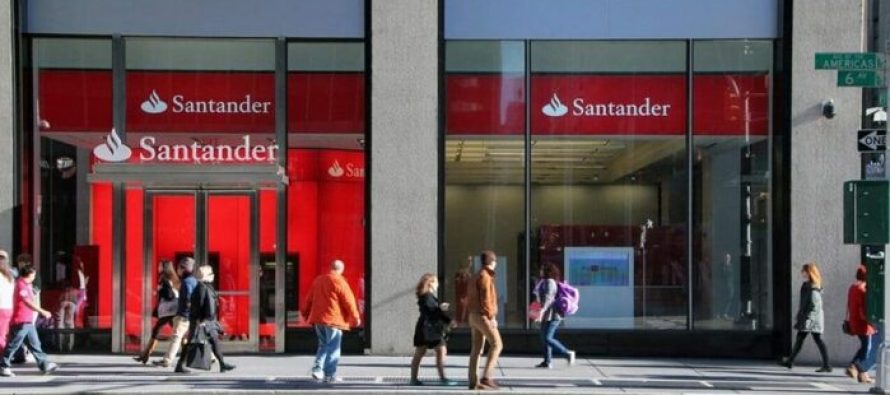
Banco Santander uses the Ethereum platform to repurchase a bond
Spanish bank Banco Santander has used the Ethereum blockchain-based platform to repurchase a bond with a face value of $20 million, before maturity. Before the bond’s maturity date, the financial institution has repurchased the bond issued on September 10, 2019, via blockchain. The transaction has clearly demonstrated the ability of the Ethereum blockchain to perform all transactions during the entire lifecycle of security.
John Whelan, Head of Digital Investment Banking at Santander, highlighted the ability of blockchain to conduct securities transactions on a blockchain. Whelan said, “We just performed an early redemption of our blockchain-based bond that we issued on September 10th, 2019. This unequivocally proves that debt security can be managed through its full lifecycle on a blockchain (public in this case).”
Whelan, who is also on the board of Enterprise Ethereum Alliance, a popular blockchain association, published Etherscan (Ethereum block explorer) links to transactions that took place on the public blockchain. Santander performed the role of issuer and investor in the transaction, enabling Whelan to reveal transactions both on issuer and investor wallet.
Nike patents shoes as a non-fungible token named CryptoKicks
Footwear and athletic apparel manufacturer Nike has patented shoes, which are tokenized as a non-fungible token (NFT), and stored on the Ethereum blockchain, The NFTs are referred to as CryptoKicks. The December 10th dated patent elaborates on the digital asset for footwear and its use. One of the use cases of the technology, as explained in the document, is an Ethereum ERC721 or ERC1155 token used to validate and buy a physical shoe.
The purchase of a shoe would unlock the token by matching a 10-digit shoe identification code with the owner identification code. The token intends to offer a way to guarantee the originality of the goods as detailed in the patent: “Prospective and current owners […] may buy and sell digital assets through one or more blockchain ledgers operating on the decentralized computing system. […] By way of example, and not limitation, a user may buy a new pair of highly sought-after sneakers from a verified vendor who may provide authenticated provenance records for the sneakers. […] After receiving the shoebox containing the purchased sneakers, the user scans the box UPC with a barcode scan feature in a sneakers app operating on the user’s smartphone.”
At the time of selling the footwear, ownership of the digital token is handed over, with an app to manage the tokens. To make it more fun, Nike has borrowed the idea from the CryptoKitties game and facilitated the digital breeding of the shoes.
JP Morgan to launch Interbank Information Network in Japan early next year
In early 2020, JP Morgan intends to roll out its blockchain-based payment system, named Interbank Information Network (IIN), in Japan. IIN, based on JPMorgan’s custom-built blockchain platform Quorum, enables accelerated payment processing while addressing key challenges of sharing info between banks. IIN has launched two years ago, and in September of 2019, Deutsche Bank, Germany’s largest bank, joined the network.
Over 80 Japanese banks have communicated their interest in joining the platform. The maximum participating banks are from Japan, accounting for 20% of the total 365 global members. The Japanese banks started joining the network in September.
Daizaburo Sanai, executive director at JPMorgan, highlighted that INN is currently being used by 70 banks across Europe, Asia, and the US. The Japanese banks, which have not started using the platform so far, are anticipated to integrate INN with their system in January 2020.
Japanese companies are interested in joining the platform to enhance their anti-money laundering process as the platform turns to monitor of cash receivers “faster and more efficient.”
Disclaimer: Any financial trading analysis offered here is our opinion and is not intended as advice or direction for investors. We cannot guarantee the success of any trades made as a consequence of this article, and we encourage traders to incorporate a strong money management strategy to limit losses when they enter the markets. Please use this article as part of your own research before formulating strategies prior to trading.


