During the 2008 financial crisis, the Swiss National Bank (SNB) officially started supporting the Euro by maintaining an exchange rate of at least 1.20. This enabled the SNB to arrest the appreciation of the Swiss Franc and further decline of the Euro. By keeping the value of the Swiss Franc artificially lower, the SNB anticipated that the country’s exporters will remain competitive in the international market.
In the meantime, in Japan, the newly elected government under Shinzo Abe resorted to the devaluation of the yen to boost exports. This deliberate move kept the CHFJPY currency pair in an uptrend, between 2012 and 2015.
The European Central Bank’s decision to implement quantitative easing measures forced the SNB to remove the peg and protect the Swiss Franc from weakening further. The news sent shivers in the forex market. The Swiss Franc retained its status once again as the safe-haven currency and appreciated strongly against all the major currencies. The CHFJPY pair hit a high of 138.89 in January 2015.
However, the plummet in the Shanghai stock market in April 2015 and the complex economic problems in the Eurozone once again shifted the focus of investors towards the Japanese Yen. This ultimately created a favorable situation for the Yen to strengthen against the Swiss Franc.
The economic woes of Switzerland also contributed to the decline of the CHF against the Yen. According to the data provided by the State Secretariat of Economic Affairs, the unemployment rate increased to 3.80% in January 2016, from 3.70% in December 2015. The recorded unemployment level is the highest since March 2010.
For January 2016, the inflation rate is -1.3% compared to the similar period last year. It is the fifteenth straight month of negative inflation in the country. For fiscal 2016, inflation is expected to remain in the negative territory with a slight improvement to -0.5%. Furthermore, the recent statement of SNB President Thomas Jordan, indicating that the Swiss Franc is still overvalued, is also likely to trigger a further decline of the CHF against the Yen.
On the other hand, the unemployment rate in Japan is 3.2% in January 2016, compared to 3.3% in December 2015. The inflation rate is -0.10 in January 2016, compared to the prior year’s corresponding period. The unexpected rate cut from BoJ (Bank of Japan) did not yield the desired results. Market participants believe that the BoJ no longer has the capacity to weaken the Yen. Thus, fundamentally, the Yen is expected to appreciate against the Swiss Franc in the coming weeks.
Technically, as shown in the image below, the CHFJPY pair has major resistance at 116.71. Major support exists at 86.70. Minor support exists at 100.82.
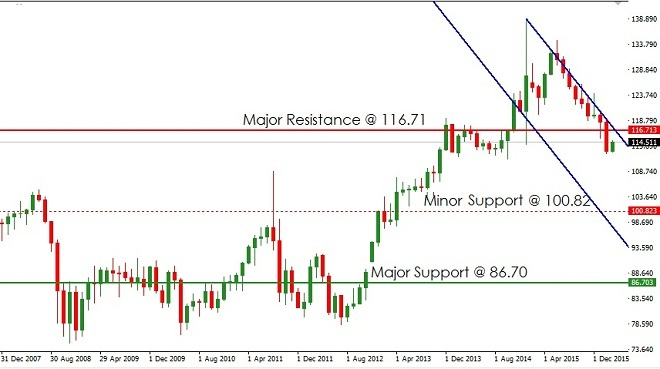
The declining channel indicates that the downtrend is intact. Thus, a forex trader can take a short position at the current level (114.50) with a stop loss above 116.80. The target for the short position is 102. A binary options trader can purchase a put option contract with expiry in March end. The suggested strike price for the put option contract is 110.
Disclaimer: Any financial trading analysis offered here is our opinion and is not intended as advice or direction for investors. We cannot guarantee the success of any trades made as a consequence of this article, and we encourage traders to incorporate a strong money management strategy to limit losses when they enter the markets. Please use this article as part of your own research before formulating strategies prior to trading.