The past two weeks saw a nascent recovery of the Pound, following a flash crash in the first week of October. Whilst the precise reasons for this crash are still unknown, the market was certainly anticipating a strong rebound of the Pound against the US dollar. Contrary to expectation, even the strong jobs data released last Wednesday was unable to propel the Pound. More importantly, a flurry of negative news emerging from Europe now indicates that the Pound will face another round of decline.
The analysts at Credit Suisse stated that the UK’s economy is in the process of undergoing a significant structural change and that a further weakening of the Pound (to the tune of 5% to 6% against the Greenback) is required to smoothen the transition. Another important point expressed by Credit Suisse is that the policymakers have not expressed any concern about the Pound’s fall. The financial institution is of the view that the BoE will not be concerned about the sharp fall in the value of the Pound, as long as there are no firm signs for loss of purchasing power in the UK.
There was also a report by Bloomberg that German officials were asked by their Chancellor to avoid official contact with their counterparts in the UK. Think tanks believe that this decision was taken mainly to avoid any kind of concession before the official Brexit related negotiations begin. Traders know for sure that the Pound is driven mainly by sensational news rather than economic data. Naturally, this news is going to encourage speculators to add to their short positions on Pound.
Meanwhile, currency traders continue to buy the Greenback in anticipation of a Fed rate hike in December. This is clearly evident from the rise of the US dollar index, as shown in the image below.

From a low of 92 in May, the US dollar index has climbed to a level of 98.54 in five months. The rise in the US dollar index reflects the market’s optimism about a Fed rate hike. Thus, considering the above facts, we anticipate the GBPUSD to decline further.
After failing to break above the resistance level of 1.2310, the GBPUSD pair has started declining. The bearishness in the currency pair is reflected by the negative value of the MACD indicator. So, a short position looks ideal at this point in time.
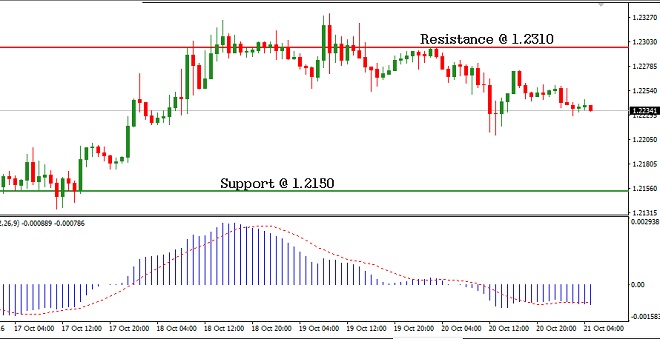
A Forex trader can go short at 1.2250 levels, with a stop-loss order above 1.2290. The profit for the short position can be taken near 1.2150.
A one-touch put option can be purchased through the trading platform of a reputed binary broker to gain from the forecasted downtrend in the exchange rate of the GBPUSD. The strike level for the put option should not be less than 1.2150. Likewise, to increase the chances of ending the trade in the money, the put option should be preferably valid until the end of the third week of November.
Disclaimer: Any financial trading analysis offered here is our opinion and is not intended as advice or direction for investors. We cannot guarantee the success of any trades made as a consequence of this article, and we encourage traders to incorporate a strong money management strategy to limit losses when they enter the markets. Please use this article as part of your own research before formulating strategies prior to trading.