

Since the beginning of this year, the Australian dollar has been weak against the developed world currency basket. Two main reasons for the weakness in the Australian dollar are poor wage growth and a mere 0.3% rise in household consumption. These two factors have forced the Reserve Bank of Australia to postpone rate hikes, a sharp contrast from what is happening in other developed countries.
The greenback, on the other hand, has been strengthened due to record low unemployment levels, robust economic growth, rising inflation, and a series of rate hikes by the US Federal Reserve. However, the AUDUSD pair, which is currently trading at 0.7660, is expected to undergo a bullish reversal in the days ahead due to the reasons given below.
Yesterday, the Australian Bureau of Statistics reported first-quarter GDP growth of 1%, versus analysts’ expectations of a 0.9% growth. In the quarter ended December 2017, the Australian economy grew by only 0.5%. On an annualized basis, the economy has grown by 3.1% during the period. It is the fastest pace of economic growth since the peak of the mining boom in 2012. Exports of goods and services increased 2.4%, following a decline of 1.5% in December. The exports of goods and services have increased 4.6% through the year.
A day before, the statistical organization also reported a decline in the first-quarter current account deficit to $10.469 billion, from $14.70 billion in the previous quarter. Even though the March quarter 2018 figures did not meet analysts’ deficit estimate of $9.9 billion, still, it is ~$4 billion lower than the deficit recorded in the previous quarter. The impressive economic data is expected to strengthen the Aussie. The greenback, in the meanwhile, is expected to weaken due to Trump’s hostile approach towards Canada, Mexico, and the European Union in trade-related matters.
The G-7 meeting is scheduled to begin today. Last weekend, the ministers and central bankers participating in the meeting have warned Trump of retaliation unless he reverses the tariffs implemented on steel and aluminum imports. Tensions have also heightened between the US and China over similar threats from the White House and a statement from Beijing indicating a suitable reciprocation.
The dignitaries of Canada, Mexico, and the EU have also issued a joint statement. “Concerns were expressed that the tariffs imposed by the United States on its friends and allies, on the grounds of national security, undermine open trade and confidence in the global economy.”
History shows that trade wars have only weakened the US dollar, and it is not going to be different this time as well. The world bank has warned that a full-fledged trade war would make the global economic scenario resemble the 2008 financial crisis. Therefore, fundamentals favor a rally in the AUDUSD pair.
The AUDUSD pair has broken the descending trend line as shown in the price chart below. Furthermore, the MACD indicator’s reading has turned positive. Therefore, a bullish reversal in the AUDUSD pair is expected.
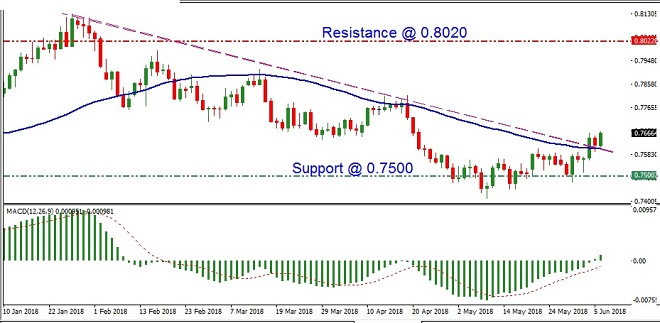
In the Forex market, we may establish a long position in the AUDUSD pair. However, a trade will be taken only if the AUDUSD pair trades near 0.7660. After opening a long trade, a stop-loss order will be placed below 0.7550. We are planning to book a profit near 0.7860 in the long trade.
Simultaneously, we may also acquire a call option contract from one of our binary brokers. We require two conditions to be satisfied to enter the trade: the contract should remain active until June 14 and the AUDUSD pair should be trading near 0.7660 in the spot Forex market.
Disclaimer: Any financial trading analysis offered here is our opinion and is not intended as advice or direction for investors. We cannot guarantee the success of any trades made as a consequence of this article, and we encourage traders to incorporate a strong money management strategy to limit losses when they enter the markets. Please use this article as part of your own research before formulating strategies prior to trading.


