Yesterday, the Aussie reversed trend to move above 0.69 against the US dollar after the unexpected general election results. Analysts, however, believe that the reversal may be short-lived as the housing market, which reflects the strength of the Australian economy, continues to degrade, while the earlier robust labor market is becoming increasingly susceptible to the global slowdown and the US-China trade war.
Despite the gloomy outlook, the Aussie managed to rebound from a low of 0.6865 to a high of 0.6938 in the past 24 hours, purely due to the positive sentiment created by the outcome of the general election.
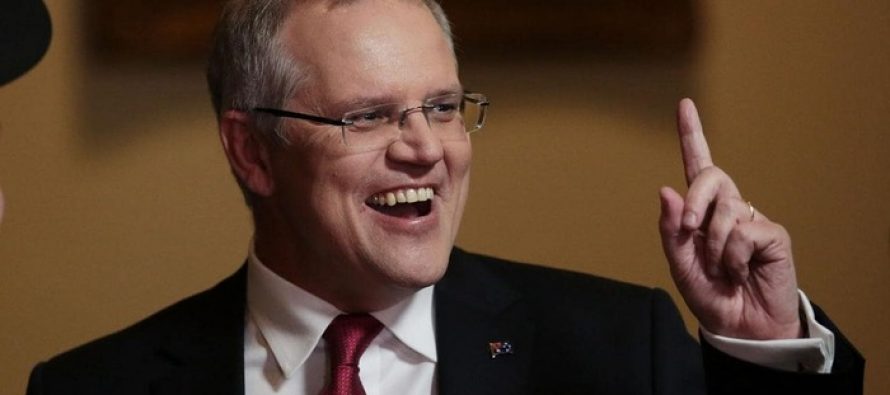
After the Australian general election, the Aussie rebounded on the opposing Labor Party’s inability to successfully unseat the ruling Liberal coalition under Scott Morrison. A key aspect of the Labor Party’s manifesto was to cancel the tax discount offered to homeowners. That plan would have likely caused further deterioration of the declining trend in the Australian home rates.
House prices have dropped so much that it raised alarm about the overall health of the economy. These concerns have become so severe that they are having a negative impact on the Aussie.
The labor market was seen as the Australian economy’s primary source of power, but there are already indications that this historic stronghold may now be deteriorating. In April, the unemployment rate grew unexpectedly by 0.1%, and lower-than-anticipated labor-related expenses indicate lack of restraints on labor supply.
Without a powerful labor market to combat the housing slowdown crisis, the threats to the economy are increasing substantially. Usually, economists argue that a slowdown in the Australian housing sector is manageable because in the majority of households there was at least one working adult who could pay the mortgage.
If this situation changes due to a weak labor market, then the Australian economy could enter a death spiral of repossession and declining house prices. Furthermore, the Aussie would get beaten as capital inflows will be severely affected. To ensure stability in the economy, the Reserve Bank of Australia has to cut interest rates. All these concerns make analysts believe that the uptrend will be short-lived.
Investors and speculators are also increasingly expecting the RBA to slash interest rates at the June 4th monetary policy meeting. The RBA Governor Philip Lowe has recently indicated that the central bank would discuss a rate cut in the June meeting. A rate cut would decrease the attractiveness of the currency to overseas investors. That would again lead to a decline in the value of the Aussie.
Regarding interest rates, Raffi Boyadijian, an economist at Forex broker XM.com, said: “As the Reserve Bank of Australia’s next policy meeting nears on June 4, traders will be looking for further confirmation from upcoming releases that the central bank will cut rates at that meeting.”
We can expect the Aussie to remain volatile with a slight bearish bias as we approach the monetary policy meeting.
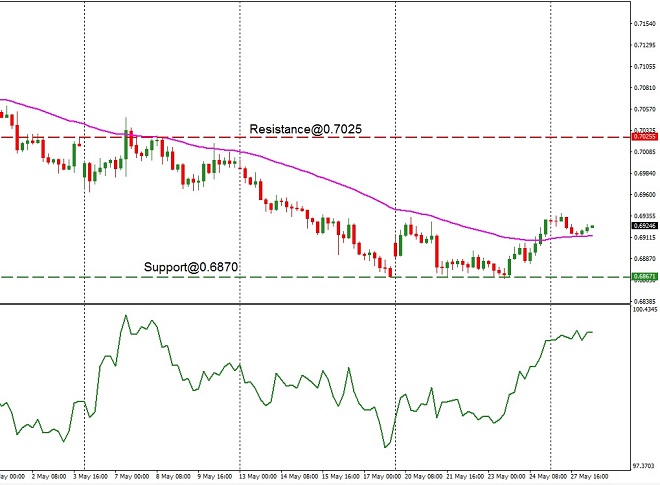
Technically, the AUD/USD pair has made a double bottom at 0.6870. The currency pair is also trading above its 50-day moving average. Additionally, the momentum indicator is rising. As a result, we can expect the AUD/USD pair to move up in the short-term. The next resistance for the pair is expected near 0.7025.
Disclaimer: Any financial trading analysis offered here is our opinion and is not intended as advice or direction for investors. We cannot guarantee the success of any trades made as a consequence of this article, and we encourage traders to incorporate a strong money management strategy to limit losses when they enter the markets. Please use this article as part of your own research before formulating strategies prior to trading.