
The eurodollar declined against the greenback yesterday after the data published by Germany’s Ifo institute indicated a decline in business confidence to a seven-year low. Economists are worried that the series of weak economic data signals a recession in Germany. The euro turned weak as Germany is the most robust economy in the Eurozone. From a high of 1.1156, the EUR/USD pair declined to a low of 1.1098 in the past 24 hours.
Germany’s business confidence declined as heightened US-China trade issues poured cold water on manufacturing activity, moving the economy to the edge of recession, according to survey results published by the Munich-based Ifo institute.
The Ifo business climate index declined to 94.30 in August, from a revised 95.80 in July. That was the fifth successive decline. The reading represents the lowest level since November 2012. Analysts had anticipated a score of 95.0.
Enterprises were not satisfied with the current business environment and pessimism about the forthcoming months also rose in August. There are increasing signals of an economic contraction in Germany, as per Ifo President Clemens Fuest.
ING economist Carsten Brzeski has opined that the German economy is experiencing an unabated decline. Brzeski also believes that the size of the stimulus package will be directly related to the depth of economic slowdown.
Bundesbank, in its August report, stated that the German economy could contract once more in the third quarter as there seems no respite for the industry slowdown. The German economy shrank 0.1% in 2Q19, nearly offsetting the 0.4% GDP growth recorded in the first quarter.
The Ifo current conditions index declined to 97.30 from 99.60 in July. Economists had anticipated the index to decrease to 98.80. The reported figure was the weakest since November 2014.
The expectations indicator fell to 91.30 in August, from 92.1 a month earlier, and the reading was also below economists’ anticipation of 91.80.
The business climate in manufacturing continued to drop in August. Current assessment degenerated and pessimism among enterprises is at its worst since the 2009 financial crisis.
Commenting on the gloomy economic scenario in Germany, Fuest said: “Not a single ray of light was to be seen in any of Germany’s key industries.”
In services, the business environment declined considerably and the relative index turned negative. However, sentiment in construction declined only slightly.
The facts presented above indicate that the euro will remain weak until positive economic data comes up from that region.
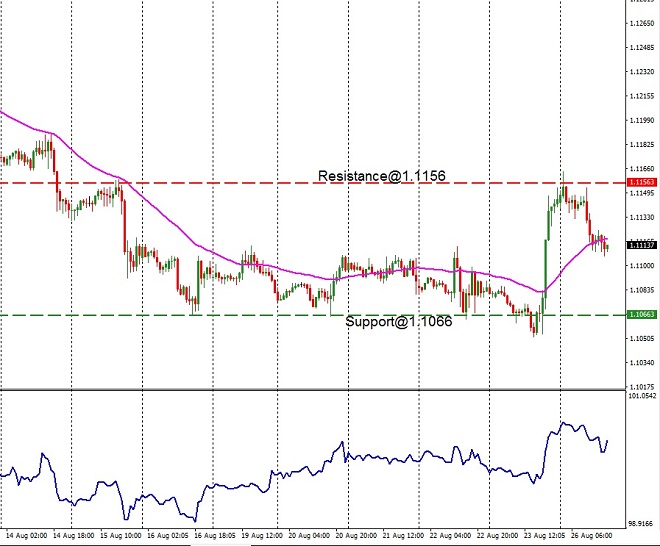
Technically, the EUR/USD is facing resistance at 1.1156. The currency pair is also trading below its 50-day moving average. The momentum indicator is also declining. As a result, we can anticipate the EUR/USD pair to drop further in the short-term.
Disclaimer: Any financial trading analysis offered here is our opinion and is not intended as advice or direction for investors. We cannot guarantee the success of any trades made as a consequence of this article, and we encourage traders to incorporate a strong money management strategy to limit losses when they enter the markets. Please use this article as part of your own research before formulating strategies prior to trading.