
The Mexican peso lost ground against a basket of currencies as the trading week nears an end, mainly due to the contraction of the economy in the first quarter of fiscal 2019. Notably, despite the economic downturn, Peso remains one of the best-performing currencies in 2019. In the past 24 hours, the USD/MXN currency pair surged about 0.6% to 19.106, after opening at 18.9954.
Mexico’s GDP declined 0.2% q-o-q in 1Q19 as services sector activity weakened, surprising analysts as it had been the only bright spot for many quarters. Analysts had anticipated GDP growth of 0.3% in the first quarter. Notably, Mexican President Andrés Manuel López Obrador had forecast a GDP growth rate of 2% for 2019. On a y-o-y basis, the GDP grew 1.3%.
The final official figures are expected in late May, but the incumbent president already blames his main opponent, former President Enrique Pena Nieto, for the underwhelming economic statistics.
President Andres Manuel Lopez Obrador pledged to stimulate the economy by 4%, although it is a challenging task. The economy suffers from a broad range of issues, from crime to a timid judicial system to deteriorating crude oil production and plummeting private investment. As of now, Obrador blames “conservative analysts” for trying to sabotage his agenda.
Obrador said: “Our adversaries are betting that things are going badly, day in and day out. They’re talking about economic stagnation, that the government is not working. In fact, we are doing well, very well. I would just like to remind you of the first quarter of the Ernesto Zedillo administration when the economy shrank by 7%. Even so, the conservatives consider that administration a success… So, bravo! We’re doing very well.”
To accomplish the president’s goals, several professionals expect central banks will trim interest rates at year-end to stimulate inflation and economic expansion. Current rates of 8.25% represent a decade-high. Several financial experts aren’t confident about Mexico’s growth prospects.
In its recent report, the Organisation for Economic Cooperation and Development (OECD) has mentioned that it anticipates Latin America’s second-largest economy to remain weak for the rest of 2019 and then perform well in 2020. The OECD predicts the economy to expand by 1.6% this year and 2.0% in 2020.
The OECD document states: “Growth will strengthen moderately in the medium term. Investment will recover on the back of planned infrastructure projects complemented with institutions conducive to private investment.”
The forecast made by OECD is in line with what the International Monetary Fund (IMF) outlook issued in April. In its World Economic Outlook, the IMF downwardly revised its prediction for Mexico’s GDP growth to 1.6% for 2019 and 1.9% for 2020.
The poor GDP figures are expected to keep the peso weak in the short-term.
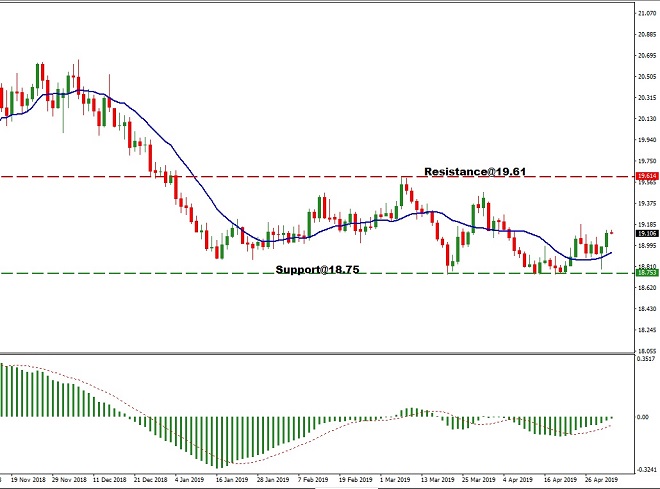
The historical price chart indicates that the USD/MXN pair has received support at 18.60. The MACD indicator’s reading is on the verge of turning positive. Additionally, the currency pair is also trading above its 50-day moving average. As a result, we are expecting the USD/MXN pair to strengthen further in the days to come.
Disclaimer: Any financial trading analysis offered here is our opinion and is not intended as advice or direction for investors. We cannot guarantee the success of any trades made as a consequence of this article, and we encourage traders to incorporate a strong money management strategy to limit losses when they enter the markets. Please use this article as part of your own research before formulating strategies prior to trading.


