

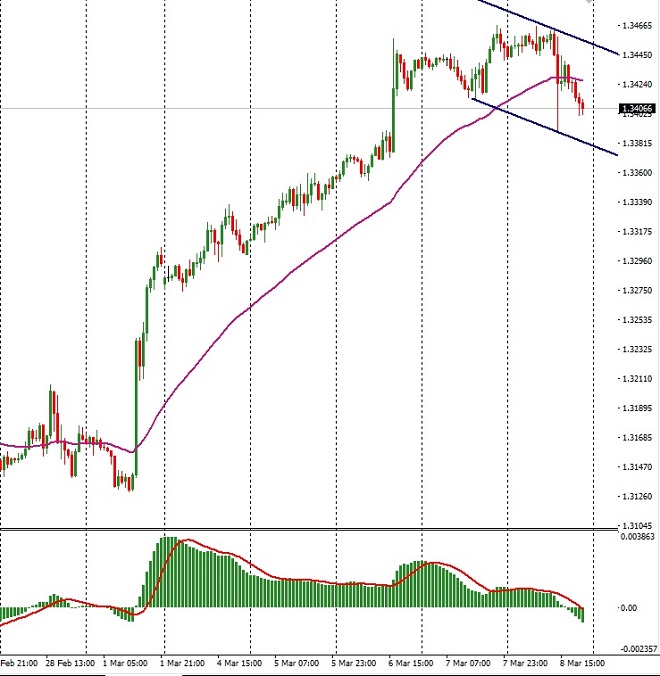
The Canadian dollar rallied against the greenback on Friday after the release of strong Canadian jobs data in the early American session. The weak non-farm employment change data from the US fueled the USD/CAD pair’s sell-off. From a high of 1.3460, the currency pair declined to a low of 1.3389 before closing at 1.3406. Notably, the currency pair broke its six-day rally.
Employment data dominates USD/CAD pair’s movement
On Friday morning, the USD/CAD pair opened near its 9-week highs following the dovish ECB rate decision announced on Thursday. However, the currency pair was soon locked in a range due to weakness in crude oil. US West Texas Intermediate crude futures declined $0.66, or 1.2%, to $56 while Brent crude futures lost 0.54 cents, or roughly 1%, to $65.76 a barrel.
The commodity had earlier hit a three-week low at $64.02 per barrel. Crude futures came under pressure after economic data indicated a sharp drop in Chinese imports and exports in February and the European Central Bank trimmed its economic growth view for the continent.
In the early US session, Statistics Canada reported that the economy added 55,900 jobs in February, versus analysts’ expectation of 1,200. In January, the economy added 66,800 jobs. The unemployment rate remained at 5.8%, unchanged from the earlier month. Hourly wage rate increased by 2.2%, compared with 1.8% last month and higher than 1.7% expected by economists.
The full-time employment change was 67,400, compared with 30,900 in the previous month, exceeding the 800 expected by analysts. Part-time jobs declined by 11,600, against the -5,700 anticipated by analysts. In January, part-time employment increased by 36,000. The release of strong employment addition data triggered the USD/CAD sell-off.
Later that day, the US Labor Department released the non-farm payroll data which indicated that the economy added far fewer jobs than anticipated, but wages increased in February. The headline figures came in at 20,000 against the expected 180,000, mainly due to the government shutdown. In the previous month, non-farm payroll figures stood at 311,000, upwardly revised from the 304,000 reported earlier. As it can be understood, it is extremely rare to see an economy recording such a steep drop in non-farm payrolls which indeed indicates a slowdown in the job market.
Following the release of weak non-farm payrolls data, the major US stock indexes declined to their session lows of the session but managed to gain most of the lost ground at the end of the day. Likely, the benchmark 10-year Treasury note yields recorded their session lows following the non-farm payrolls data release. The US dollar fell against the currency basket, including the euro and the loonie.
The US Dollar Index also recorded its session low. The weak employment data is expected to keep the US dollar bearish in the days to come.
Technically, the USD/CAD pair has declined below its 50-day moving average. Additionally, the oscillator of the moving average also has a negative reading. As a result, we are expecting the currency pair to remain bearish in the short-term.
Disclaimer: Any financial trading analysis offered here is our opinion and is not intended as advice or direction for investors. We cannot guarantee the success of any trades made as a consequence of this article, and we encourage traders to incorporate a strong money management strategy to limit losses when they enter the markets. Please use this article as part of your own research before formulating strategies prior to trading.


