After hitting a 12-month high of $111.60, the shares of global insurance provider AON Plc (NYSE: AON) have started declining. This decline is primarily attributed to lower than expected fiscal 2016 second-quarter operating earnings and revenue. Considering the headwinds faced by the company, as explained below, the market participants are expected to have a negative view of the stock and so the share price is expected to remain range-bound with a bearish bias. Aon ended the previous trading day at $109.71.
The London-based company reported second-quarter revenue of $2.76 billion and missed the Wall Street estimates of $2.85 billion. The fiscal 2015 second-quarter revenue of $2.80 billion is about 1% higher than the revenue posted in the second quarter ended June 2016. The negative impact of the currency exchange rate and decrease in the commissions resulted in a decline in the revenue.
The Risk Solutions segment, comprising of retail, reinsurance, and investment income, reported Q2 2016 revenue of $1.85 billion, up 1% from $1.83 billion in Q2 2015. The HR solutions segment, comprising of consulting services, outsourcing, and intersegment, reported a 5% decline in the 2016 second-quarter revenue to $931 million, from $979 million in the last year.
During the second quarter, the net income rose 53% to $272 million or $1.01 per share, from $178 million or $0.62 per share in the second quarter last year.
Excluding items, the quarterly adjusted net income of $376 million or $1.39 per share was lower than the Zacks estimate of $1.40 per share. The fiscal 2015 non-GAAP net income was $375 million or $1.31 per share.
As of June 2016, the net debt of Aon increased to $5.9 billion, from $5.1 billion in the quarter ended December 2015. The uncertainty in Europe is also expected to affect the performance of the company in the current quarter. The COO (Europe, Middle-east, and Africa) Richard Kirby stated that the slowdown and the reduction in the labor force are expected to affect the demand for health and benefits products. Thus, fundamentally, the share price is expected to trade between $102 and $110 during the third quarter.
The price chart reveals a negative divergence formation by the RSI indicator. Unable to cross the resistance at 110, the stock is declining towards the minor support at 105. Major support for the stock exists at 95.
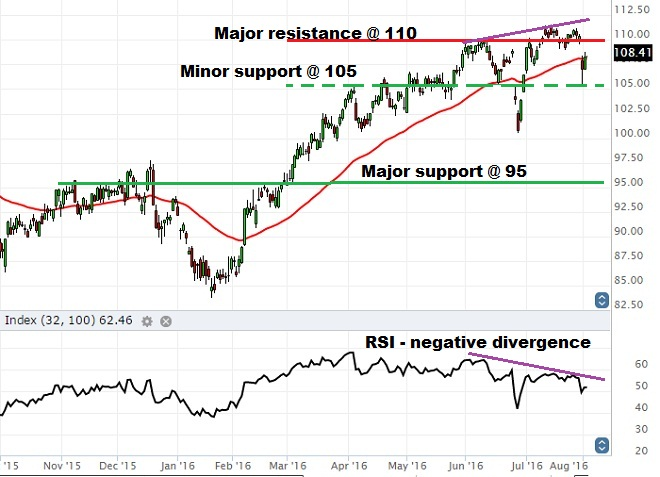
It is advisable to take a short position at higher levels in the stock. Correspondingly, a one-touch put option can be bought in the derivatives market through a binary broker of choice. The strike price of the option contract should be about $102. The contract should also carry an expiry period of at least one month.
Disclaimer: Any financial trading analysis offered here is our opinion and is not intended as advice or direction for investors. We cannot guarantee the success of any trades made as a consequence of this article, and we encourage traders to incorporate a strong money management strategy to limit losses when they enter the markets. Please use this article as part of your own research before formulating strategies prior to trading.