

The euro remained rangebound against the greenback yesterday despite the release of lower-than-anticipated German retail sales data for April. The US ADP non-farm employment data also blew away forecasts. Still, the uncertainty in the US debt ceiling, which needs to be approved by the Senate, is keeping the US dollar slightly weak. Overall, the EUR/USD pair traded in a narrow range of 1.0665 and 1.0715 in the past 24 hours.
According to Destatis, the country’s retail sales rebounded with a growth of 0.80% m-o-m in April following a 2.20% decline in the previous month but missed forecasts of a 1% increase.
Food retail posted an increase of 0.50%. Likewise, non-food sales grew by 0.70%. Online and mail-order sales surged 5.90% in April.
On a y-o-y basis, retail sales fell by 4.30% in April 2023. The decline was led by a 4.40% drop in food sales. Also, non-food sales declined by 4%.
According to a flash estimate published by Eurostat, the eurozone inflation stood at 6.10% y-o-y in May, down from 7% in the previous month and a few notches below the forecast of 6.30%.
Food, alcohol, and tobacco prices rose by 12.50% y-o-y in May. Likewise, non-energy industrial goods prices grew by 5.80%. Also, services recorded an increase of 5%. However, energy prices fell by 1.70% y-o-y in May.
Excluding energy, food, alcohol, and tobacco, the country’s core consumer price index rose by 5.30% y-o-y in May. This compares with a 5.60% rise in the previous month. Economists had anticipated the core inflation to be 5.50% in May.
The Eurostat also stated that unemployment inched down to 6.50% in April, down from 6.60% in the previous month. The initial estimates pegged the unemployment rate at 6.50%. Economists had anticipated no change in the unemployment rate.
At the end of April, 11.088 million remained unemployed in the Eurozone. On a m-o-m basis, unemployment fell by 33,000 in the Eurozone. On a y-o-y basis, unemployment fell by 203,000 in the Eurozone in April 2023.
According to the data published by Automatic Data Processing, Inc., the US non-farm payrolls increased by 278,000 in May following an addition of 291,000 jobs in the previous month and pleased economists who were expecting only 173,000 job additions.
The goods-producing sector added 110,000 jobs. Specifically, the natural resources/mining sub-sector added 94,000 jobs while construction added 64,000 jobs. Manufacturing lost 48,000 jobs.
The service-providing sector added 168,000 jobs. In particular, the trade/transportation/utilities sub-sector added 32,000 jobs. Also, the leisure/hospitality sub-sector recorded an addition of 208,000 jobs. However, the information and financial activities sub-sector lost 15,000 and 35,000 jobs, respectively. Professional/business services lost 5,000 jobs. Similarly, education/health services lost 29,000 jobs.
Despite the weak Eurozone economic data, the uncertainty in the debt ceiling which needs to be approved by the senate, is expected to keep the EUR/USD pair range bound in the short term.
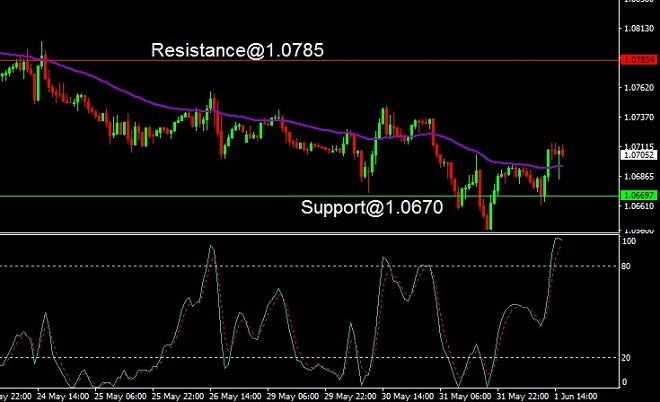
The historical price chart indicates that the EUR/USD pair is rising after testing the support at 1.0670. The next resistance is anticipated only near 1.0785. Additionally, the currency pair is trading above its 50-day moving average while the stochastic indicator is in the bullish zone. Therefore, we anticipate the EUR/USD pair to rally further in the days ahead.
Disclaimer: Any financial trading analysis offered here is our opinion and is not intended as advice or direction for investors. We cannot guarantee the success of any trades made as a consequence of this article, and we encourage traders to incorporate a strong money management strategy to limit losses when they enter the markets. Please use this article as part of your own research before formulating strategies prior to trading.


