
The loonie remained range bound against the yen yesterday following the release of solid economic data from both Japan and Canada. While Japan’s PPI (producer prices index) surpassed estimates for April, Canada’s housing starts blew past expectations for the same period. Overall, the CAD/JPY pair traded in a narrow range of between 100.02 and 100.58 in the past 24 hours.
According to the data published by the Bank of Japan, the corporate goods price index (CGPI) rose by 5.80% y-o-y in April following a 7.40% increase in the previous month, which pleased economists who were expecting a growth of 5.60%. The reported figure, which reflects the fourth month of a slowdown in PPI, was the lowest recorded producer inflation since August 2021. The data indicates that the effect of previous increases in raw material costs has withered.
The decline was led by a 17.90% year-on-year decrease in the cost of lumber and wood. Likewise, petroleum fell by 6.60%. On the contrary, prices for beverages and foods grew at a slower pace of 7% in April. Also, chemicals posted a slower growth of 1.90%. While non-ferrous metals recorded a decline of 2.70% in April, transport equipment posted a growth of 3.80%. During the same period, inflation rose by 5.10% for machinery.
On a m-o-m basis, Japan’s PPI inched up 0.20% in April following a 0.10% rise in March. The third-largest economy’s core consumer inflation rose to 3.10% in March. The country’s Governor, Kazuo Ueda, has stated that the central bank will maintain an ultra-loose monetary policy until inflation is led by solid domestic demand and backed by impressive wage growth.
According to the preliminary data published by the Japan Machine Tool Builders Association (JMTBA), the country’s machine tool orders declined 14.40% y-o-y in April to ¥132.67 billion from ¥141.02 billion in March.
According to the data published by the Canada Mortgage and Housing Corporation (CMHC), the total housing starts were 261,559 units in April, up 22% from 213,780 units in the previous month and greater than forecasts of 221,000 units.
The total urban starts rose by 26% m-o-m to 241,585 units in April. Likewise, multi-unit urban starts grew by 33% to 201,621 units. However, single-detached urban starts fell by 2% to 39,964 units. Also, rural starts were 19,974 units in April.
Furthermore, the trend in housing starts was 240,403 units in April, a decrease of 0.20% from 240,876 units in March.
According to the data published by Statistics Canada, the country’s wholesale sales fell by 0.10% m-o-m in March to C$86.50 billion, following the 1.70% decline in February and slightly better than preliminary estimates of a 0.30% decrease. Economists did not anticipate any change in the preliminary estimates.
Four out of seven subsectors posted declines. Miscellaneous goods recorded a decrease of 6.10% in March against the backdrop of a 15.50% drop in agricultural supplies. Machinery, equipment, and supplies posted a decrease of 2%. On the contrary, building materials and supplies recorded a growth of 1.60%, while personal and household goods reported a rise of 1.30%.
The solid economic data from both countries are expected to keep the CAD/JPY pair range bound in the short term.
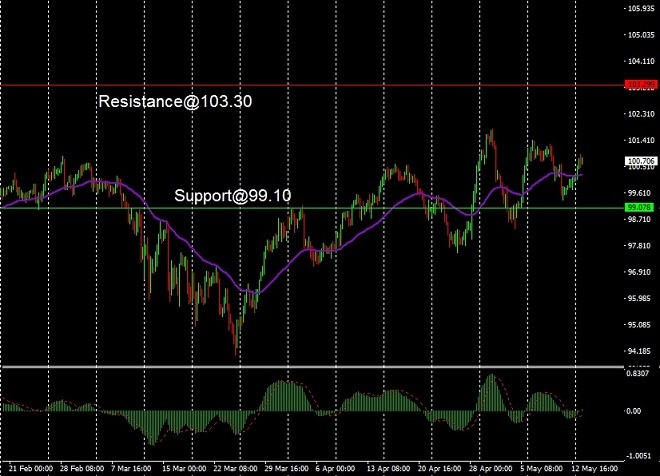
The historical price chart indicates that the CAD/JPY pair is rising after testing support at 99.10. The next resistance is anticipated only near 103.30. Additionally, the currency pair is trading above its 50-day moving average while the MACD indicator is showing a positive reading. Therefore, we anticipate the CAD/JPY pair to remain in an uptrend in the near term.
Disclaimer: Any financial trading analysis offered here is our opinion and is not intended as advice or direction for investors. We cannot guarantee the success of any trades made as a consequence of this article, and we encourage traders to incorporate a strong money management strategy to limit losses when they enter the markets. Please use this article as part of your own research before formulating strategies prior to trading.