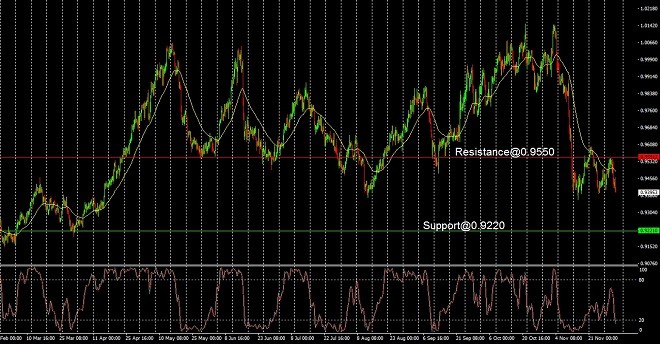
The Swiss franc strengthened against the greenback yesterday despite reports of an unexpected decline in retail sales data for October. The US unemployment claims and personal income data exceeded expectations. However, the slowdown in the personal consumption expenditures (PCE) price index (reflecting inflation) has boosted hopes of a slower interest rate hike by the Fed in the coming months. This enabled the franc to gain ground against the greenback. Overall, the USD/CHF pair declined from a high of 0.9550 to a low of 0.9370 in the past 24 hours.
According to the Federal Statistical Office, the Swiss consumer price index (CPI) stood unchanged in November compared with the prior month and in line with economists’ estimates. Correspondingly, the index was 104.60 in October.
On a y-o-y basis, the Swiss CPI grew by 3% in October 2022.
Core inflation, which excludes fresh (and seasonal) products, energy, and fuel, rose by 0.10%m-o-m in October to 102.70. On a y-o-y basis, core inflation surged by 1.90% in October 2022. The CPI for domestic products remained unchanged in October, with the corresponding index at 102.60. On a y-o-y basis, the CPI of domestic products jumped 1.80% in October 2022. Also, the CPI of imported products fell by 0.10% to 111. On a y-o-y basis, the CPI of imported products grew by 6.30%.
In a separate news release, the Federal Statistical Office stated that the country’s retail sales declined by 2.50%y-o-y in October, following a 3.20% rise in the prior month and disappointing economists who were expecting a 3.50% rise. On a m-o-m basis, retail sales decreased by 2.70% in October.
The retail trade, devoid of petrol stations, posted a 0.60% y-o-y decrease in October 2022. Also, the retail trade of food, beverages, and tobacco posted a 1.20% drop in the same period. Likewise, the non-food sector recorded a 3.50% decline.
According to the data published by the US Bureau of Economic Analysis, the country’s personal income rose by 0.70% m-o-m in October to $155.30 billion, following a 0.40% rise in the prior month. Economists anticipated only a 0.40% rise in personal income.
Disposable personal income grew by 0.7% in October to $132.90 billion. Likewise, personal consumption expenditures increased by 0.80% to $147.90 billion.
The PCE (personal consumption expenditures) rose by 0.30% m-o-m in October. Excluding food and energy, the PCE price index grew by 0.20%m-o-m in October, following a rise of 0.50% in September but a notch lower than forecasts of a 0.30% growth.
According to the US Department of Labor, first-time jobless claims declined to 225,000 in the week ended November 26 from 241,000 (upwardly amended from 240,000) in the prior month and bettered the 234,000 unemployment claims anticipated by economists. The four-week moving average was 228,750, up from 227,000 (upwardly revised from 226,750) in the previous week.
The weak Swiss retail sales data and the mixed US economic data are expected to keep the USD/CHF pair range-bound for the next few trading sessions.
The historical price chart indicates that the USD/CHF pair is declining after facing resistance at 0.9550. The next support is anticipated only near 0.9220. Additionally, the currency pair is trading below its 50-day moving average, while the stochastic indicator is in the negative region. Therefore, we anticipate the currency pair to remain in a downtrend in the days ahead.
Disclaimer: Any financial trading analysis offered here is our opinion and is not intended as advice or direction for investors. We cannot guarantee the success of any trades made as a consequence of this article, and we encourage traders to incorporate a strong money management strategy to limit losses when they enter the markets. Please use this article as part of your own research before formulating strategies prior to trading.