
The Aussie rallied against the greenback yesterday despite the release of lower-than-anticipated job additions in April. The slightly better unemployment rate enabled the Australian dollar to gain ground against the US dollar. Additionally, the unexpected rise in the US unemployment claims to the highest level since January 2022 enabled the AUSD/USD pair to cement its gains. Overall, the AUD/USD pair rallied from a low of 0.6950 to a high of 0.7072 in the last 24 hours.
According to the data published by the Australian Bureau of Statistics, the country’s economy added 4,000 jobs in April, following an addition of 17,900 jobs in the prior month and disappointed economists who were anticipating an addition of 30,000 jobs. Overall, the number of employed people was 13,401,700. Compared with March 2020, employment was 3.10% or 399,400 higher.
Correspondingly, the unemployment rate inched lower to 3.90% in April, from 4% in the prior month and in line with economists’ estimates.
Compared with March 2020, the unemployment rate stood 1.40 points lower. Also, jobless people fell by 11,000 to 537,100 in April. The count of jobless individuals was 182,300 lower than in March 2020.
Full-time employment rose by 92,400 to 9,342,900 people. Part-time employment accounted for 30.30% of overall employment, a decrease of 1.50 points from the March 2020 level.
The employment-to-population ratio stood unchanged at 63.80%, an increase of 1.40 points from March 2020. However, the participation rate fell by 0.10% to 66.30%, but stood 0.50% higher than in March 2020.
While the underemployment rate fell by 0.20% to 6.10% in April, the underutilization rate declined by 0.30% to 10%.
According to the manufacturing survey data published by the Federal Reserve Bank of Philadelphia, the current activity index slumped to two year low of 2.60 in May, from 17.60 in the prior month and disappointed economists who were anticipating a reading of 14.90.
The new orders index grew by 4 points to 22.10, while the current shipments index surged 16 points to 35.30, the highest level since October 2020.
The current employment index stands at 25.50, down 16 points from April. Also, the average workweek index fell by 5 points to 16.10. Notably, the prices index, which reached a 43-year high in April, decreased 6 points to 78.90 in May. Likewise, the current prices received index inched lower by 3 points to 51.70.
Worrisomely, the index representing future general activity plunged to 2.50 in May, reflecting the lowest level in over 13 years, from 8.20 in April. The future employment index also dropped 10 points to 29.20.
According to the US Department of Labor, the first-time unemployment claims increased to 218,000 in the week ended May 14, from 203,000 (upwardly revised from 197,000) in the earlier week and disappointed economists who were anticipating a drop in the unemployment claims to 200,000.
The four-week moving average was 199,500, an increase from 191,250 (downwardly revised from 192,750) in the earlier week.
The weak economic data from both the US and Australia is expected to keep the AUD/USD pair range-bound in the short term.
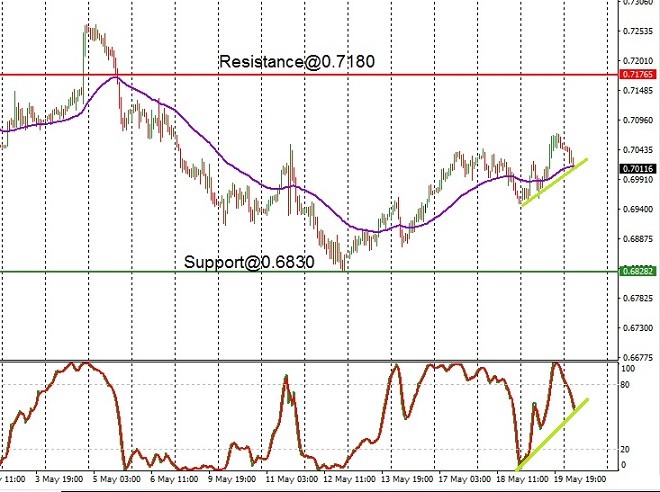
The historical price chart indicates that the AUD/USD pair is rising after testing the support at 0.6830. The next resistance is anticipated only near 0.7180. Additionally, the AUD/USD pair is also trading above its 50-day moving average. Therefore, we are anticipating the currency pair to remain in an uptrend in the short term.
Disclaimer: Any financial trading analysis offered here is our opinion and is not intended as advice or direction for investors. We cannot guarantee the success of any trades made as a consequence of this article, and we encourage traders to incorporate a strong money management strategy to limit losses when they enter the markets. Please use this article as part of your own research before formulating strategies prior to trading.