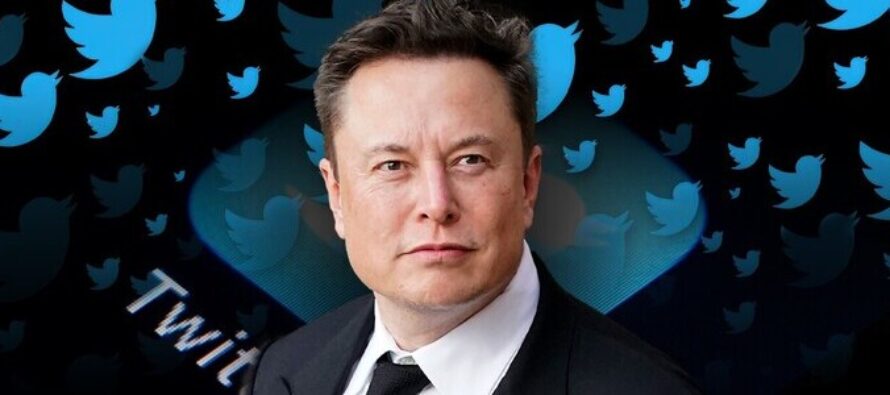
Twitter Inc (NYSE: TWTR) caught the market’s attention for the wrong reasons on Friday after Tesla’s CEO Elon Musk announced that his agreement to take over the social media platform provider was put off “temporarily” as he is waiting for information on the count of duplicate and spam accounts existing on the platform. Following the revelation, the stock of Twitter lost $4.51 or 10.01%, to close at $40.57.
Notably, two hours later, Musk issued another tweet stating that he remains dedicated to the takeover. Before the aforesaid decision was revealed, Twitter’s market cap had dropped $9 billion below the offer price on worries about the takeover agreement.
In April, Musk revealed his intention to acquire the San Francisco, California-based company for $44 billion. Interestingly, the Chief Engineer at SpaceX had earlier tweeted that one of his top focuses will be eliminating what he refers to as “spam bots,” from the site.
Musk, who is anticipated to perform the role of temporary CEO in case the deal moves forward, is obliged to shell out $1 billion if he decides to terminate the deal permanently. The breakup fee is not a huge figure considering the fact that the net worth of Elon Musk is over $220 billion. A few weeks before, Twitter had disclosed that less than 5% of the platform’s cashable daily active users were spam accounts or bots. The disclosure was made through a filing based on first-quarter data.
Elon Musk now prefers the spam accounts data to be confirmed by the company before moving forward with the acquisition. Even though Musk is the richest person in the world, the takeover is partly financed by venture capital firm Andreessen Horowitz, in addition to Larry Ellison, the co-founder of Oracle.
In its filing, Twitter had also disclosed that the platform had served advertisements to 229 million users in the first quarter. Earlier last Tuesday, Musk had mentioned his intention to repeal Twitter’s prohibition on ex-President Donald Trump after taking over the micro-blogging platform.
While speaking at FT Live’s Future of the Car conference, Musk said: “Permanent prohibitions should be very uncommon and basically only be designated for profiles that are bots, spam or even scams… I am of the opinion that it was not appropriate to exclude Donald Trump. I believe it was a poor decision because it turned off support from a significant portion of the nation but did not, in the end, prevent Donald Trump from having a say in various matters.”
Earlier in May, Bill Gates cautioned that Musk could transform Twitter into a “worse” platform. While having a talk at The Wall Street Journal’s CEO Summit, Gates stated that he has no clarity about the strategy that would be adopted by Musk to bring about a drastic change in Twitter, in case the deal goes through. He also expressed worries about the dissemination of false information on the social media platform.
Interestingly, before Elon Musk made an attempt to take over Twitter, he did not reveal a ~9% ownership in the company within the compulsory 10-day time frame stipulated by the US SEC. There are reports that the timing of Elon Musk’s revelation is being scrutinized by the Federal Trade Commission (FTC). Furthermore, a Bloomberg news report indicates that the FTS is also scrutinizing the takeover deal as a whole, although experts do not feel that the deal will bring up antitrust issues.
Elong Musk’s announcement is expected to keep the stock of Twitter volatile with a slight bearish bias in the short term.
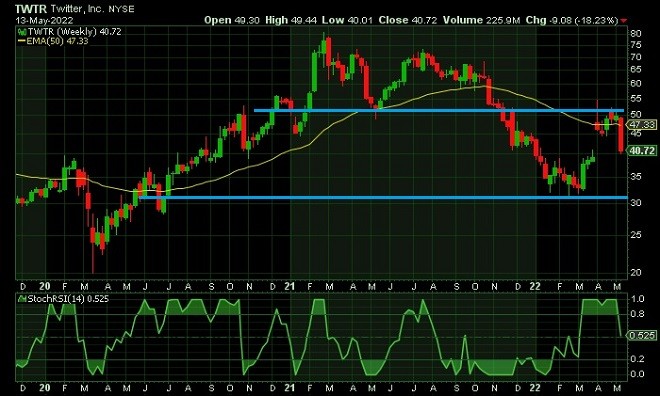
The historical price chart indicates that the stock is declining after facing resistance at 52. The next support is anticipated only near 35. Additionally, the stock has closed below its 50-day moving average, while the stochastics RSI indicator has a negative reading. Therefore, we are anticipating the stock to remain in a downtrend in the short term.
Disclaimer: Any financial trading analysis offered here is our opinion and is not intended as advice or direction for investors. We cannot guarantee the success of any trades made as a consequence of this article, and we encourage traders to incorporate a strong money management strategy to limit losses when they enter the markets. Please use this article as part of your own research before formulating strategies prior to trading.