
The Japanese yen and the euro traded in a narrow range on the first day of the week following the release of weak economic data from both Germany and Japan. The flash manufacturing PMI from both Germany and Japan missed estimates. The German services PMI was better than the market’s expectations. However, the euro bulls were unable to capitalize on the data. The ongoing Russia-Ukraine issue also aided the yen, a safe haven currency, to hold on to its ground. Overall, the EUR/JPY pair traded in a narrow range of between 129.97 and 131.
According to the data published by the au Jibun Bank, Japan’s flash manufacturing PMI (purchasing managers’ index) declined to 52.90 in February, from 55.40 in January in the prior month, but slightly lower than the reading of 55 anticipated by economists. A reading above 50 indicates expansion and vice-versa. The reported reading reflects the slowest pace of growth in five months. The index also mirrored a drop in output, highlighting the continuous negative effect of worldwide supply chain issues on the third-largest economy of the world.
The flash services business activity index declined to 42.70 in February, from 47.60 in the prior month. Also, the flash manufacturing output index fell to 48.70 in February, from 54.80 in January. Notably, services sector activity shrank at the quickest pace since May 2020 as demand slowed down after the country recorded a spike in COVID-19 infections due to the Omicron variant.
Overall, the flash composite output index decreased to 44.60 in February, from 49.90 in January. The reported reading reflects the lowest level since June 2020 (40.80). The survey also indicated a notable extension of delivery times, intensified material scarcity, paving the way for a surge in input prices at the quickest pace since August 2008.
Manufacturers reported input costs of raw materials increased at the steepest rate since the organization started documenting data in October 2001. The survey also indicated that both manufacturers and service-sector companies turned less positive about the business environment in the year ahead.
A report published by IHS Markit indicated that the German flash manufacturing PMI declined to a two–month low of 58.50 in February, from 59.80 reported for the previous month and missed the reading of 59.60 anticipated by economists.
Also, the German flash manufacturing output index fell to a two-month low of 55.40 in February, following the reading of 57 in the prior month.
However, the country’s flash services PMI hit a six-month high of 56.60 in February, compared with 52.20 in the prior month and greater than the reading of 53.20 anticipated by economists.
Overall, the German flash PMI composite output index recorded a six-month high of 56.20 in February, following a reading of 53.80 in January.
The increase in the index was mainly due to the quicker growth of service sector activities, reflecting the fastest level since August 2021. Goods production also increased, but at a slightly lower rate than January. The slowdown was mainly due to the absence of employees due to the spread of COVID-19 (omicron variant).
On the contrary, fresh orders in the manufacturing sector rose at the fastest rate since August 2021. The service sector also posted a sustained improvement in demand, with fresh orders rising at the quickest rate since September 2021.
Export orders rose at the quickest rate in four months. Also, for the third successive month, backlogs of work increased.
Notably, for the 14th month in a row, private sector employment increased, and the rate remained far higher than the historical series average. Service providers recorded a slight slowdown in workforce growth. On the other hand, manufacturers posted an increase in employment at a robust rate since July 2021. February data also reflected the strongest projections about future economic activity for eight months.
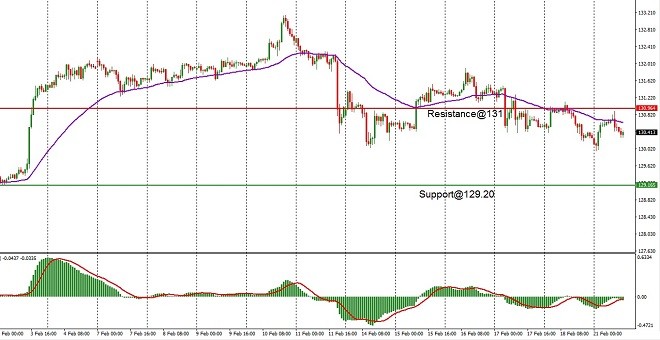
The mixed economic data is anticipated to keep the EUR/JPY pair range-bound in the short term.
The historical price chart indicates that the EUR/JPY pair is declining after facing resistance at 131. The next support is anticipated only near 129.20. Additionally, the currency pair is trading below its 50-day moving average, while the MACD indicator has a negative reading. Therefore, we are anticipating the currency pair to remain in a downtrend in the near term.
Disclaimer: Any financial trading analysis offered here is our opinion and is not intended as advice or direction for investors. We cannot guarantee the success of any trades made as a consequence of this article, and we encourage traders to incorporate a strong money management strategy to limit losses when they enter the markets. Please use this article as part of your own research before formulating strategies prior to trading.