The Eurodollar remained range-bound against the Japanese yen on the first day of the trading week despite the release of worse-than-anticipated third-quarter GDP data from Japan.
The Nikkei news report indicates that the government of Japan intends to roll out another round of stimulus packages to support the economic rebound. This keeps the yen from declining further against the Eurodollar.
Interestingly, the Eurozone trade data was better than anticipated. However, this did not deter the market from making bullish bets on the yen. Overall, the EUR/JPY pair remained range-bound between 130.28 and 130.60.
According to the preliminary data published by Japan’s Cabinet Office, the country’s economy shrank 0.80% q-o-q in the September quarter, following an expansion of 0.50% in the June quarter and worse than the 0.20% contraction anticipated by economists.
The economic contraction highlights the necessity for Prime Minister Fumio Kishida to stitch together a solid stimulus package to aid the economic rebound.
On an annualized basis, the GDP contracted 3% in the September 2021 quarter, versus a 0.70% decline anticipated by economists.
Notably, the economy has contracted for the first time in two quarters. However, the economy shrank in five of the last eight quarters. The shortage of semiconductor chips and other components continues to affect the supply chain.
As per a report published by the Nikkei, the Prime Minister intends to roll out a stimulus package exceeding ¥40 trillion ($350 billion), including handouts of ¥100,000 to 18 years and younger.
Private consumption decreased at a yearly pace of 4.50% q-o-q in the September quarter. Capital spending fell by 14.40%. Government spending surged 4.70%. Exports declined 8.30%, but steeper drops in imports imply trade contributed slightly to the overall growth. The International Monetary Fund predicts Japan to record the slowest growth among G7 countries in 2022.
According to the revised data published by the Japanese Ministry of Economy, Trade and Industry (METI), industrial production contracted 5.40% m-o-m in September, following a 3.60% contraction in the previous month. The preliminary estimates had forecast the industrial production to contract by 5.40%. Economists did not anticipate any change in the preliminary estimates. Correspondingly, the production index stood at 89.50.
Likewise, the shipments fell by 6.1% m-o-m in September. The corresponding index stood at 86.50 (a notch lower from 86.60 reported in the preliminary report). Inventories rose by 3.40% m-o-m in September. The inventories index was 98.40, up from 98.10 indicated in the preliminary report. Also, the inventory ratio increased 5.50%, and the index stood at 120.40 (an increase from 119.90 mentioned in the preliminary report).
According to Eurostat, the Eurozone trade surplus widened to €7.30 billion in September, from €4.80 billion in August. On a y-o-y basis, the Eurozone trade surplus narrowed to €7.30 billion in September 2021, from €24.10 billion in September 2020, and surpassed economists’ expectations of €6.50 billion.
While exports surged 10% y-o-y to €209.30 billion, imports jumped by 21.60% to €202 billion as the cost of energy imports skyrocketed. Notably, in the first nine months of 2021, the Eurozone trade surplus declined to €131.90 billion, from €151.20 billion in the first nine months of 2020 as exports surged 14.70% and imports grew by 17.70%.
Interestingly, with Russia, the European Union’s trade deficit widened to roughly €43 billion in the initial nine months, from €13 billion in the similar period last year. With Norway, the EU recorded a trade deficit of €4.40 billion, compared with a €4.10 billion surplus last year. Concerning the UK, the EU’s trade surplus increased to €105.30 billion, from €77 billion as export grew by 4.50% and imports declined 16%.
The weak economic data from Japan and growth worries in Europe on natural gas issues and COVID-19 are expected to keep the EUR/JPY pair range-bound with a slight bearish bias in the short term.
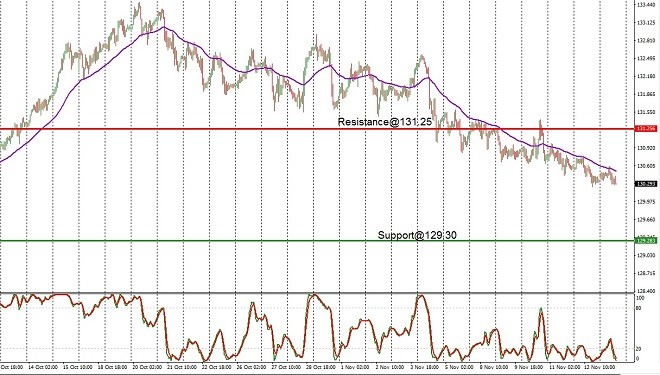
Technically, the EUR/JPY pair is declining after facing resistance at 131.25. The next support is anticipated only near 129.30. Additionally, the currency pair is trading below its 50-day moving average, while the stochastics indicator is in the bearish zone. Therefore, we are anticipating the currency pair to remain in a downtrend in the near term.
Disclaimer: Any financial trading analysis offered here is our opinion and is not intended as advice or direction for investors. We cannot guarantee the success of any trades made as a consequence of this article, and we encourage traders to incorporate a strong money management strategy to limit losses when they enter the markets. Please use this article as part of your own research before formulating strategies prior to trading.