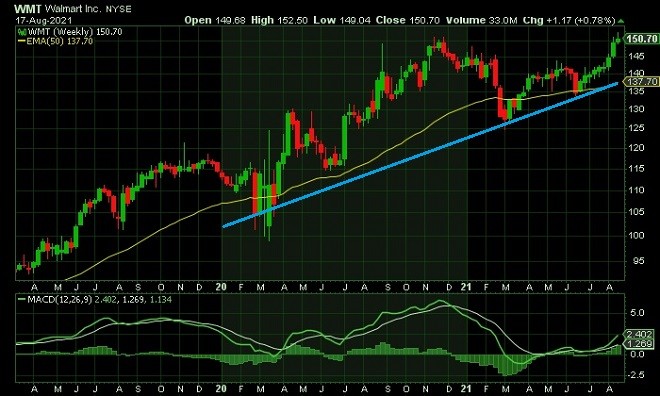
Hypermarket chain Walmart Inc (NYSE: WMT) reported better-than-anticipated fiscal 2022 second-quarter earnings and revenues. However, the second-quarter profit declined 34% y-o-y due to an increase in expenses and a decrease in margins. The grocery chain also upwardly revised its outlook for FY22. The stock closed at $150.70, almost unchanged from the prior close.
Bentonville, Arkansas-based Walmart reported 2Q 2022 revenues of $141.048 billion, up 2.4% from $137.742 billion in the comparable period last year. Divestitures had a negative impact of $8.90 billion on the company’s revenues.
For the quarter ended July 31, 2021, the company posted a net income of $4.276 billion, or $1.52 per share, compared with a net income of $6.476 billion, or $2.27 a share in the quarter ended July 31, 2020.
Excluding unrealized and realized gains and losses on the company’s equity investments, Walmart recorded Q2 2022 adjusted net income of $1.78 per share, an increase from $1.56 a share in Q2 2021.
Analysts surveyed by Refinitiv had anticipated Walmart to report $1.57 per share in earnings on revenues of $137.17 billion for the reported period.
Commenting on the results, Doug McMillon, President and CEO of Walmart, said, “We had another strong quarter in every part of our business. We grew market share in US grocery, […], and we’re finding innovative ways to commercialize our data and build technology.”
Segment-wise,
- Walmart US posted revenues of $98.192 billion, an increase of 5.3% from last year.
- Walmart international revenues declined 15.2% y-o-y to $23.035 billion.
- Sam’s Club revenues rose by 13.90% to $18.644 billion.
- Membership and other revenues were $1.177 billion, compared with $918 million in the prior-year period.
Notably, in the second quarter, e-commerce sales grew only by 6%, compared with 97% in the prior-year period. The company had recorded e-commerce sales growth of 37% and 69% in the first and fourth quarter, respectively. Overall, Walmart had recorded more than 100% growth in e-commerce sales in the last two years. Walmart’s US profit margin rose by 0.20%. However, the consolidated gross profit margin fell by 0.15%.
The same-store sales of Walmart US increased 5.20% year-on-year and surpassed the 3.30% growth forecast by StreetAccount analysts. The reported comp sales, however, was lower than the 9.30% growth recorded in the year-ago quarter. Furthermore, in the last two years, Walmart’s same-store sales have grown by 14.50%.
Likewise, excluding fuel, same-store sales of Sam’s Club rose by 7.70%, more than double the 3.70% increase forecast by analysts. Overall, consolidated US comp sales, without fuel, grew by 5.50%.
Walmart expects Sam’s Club to post same-store sales growth in the range of 7.50% to 8.50% in FY 2022, devoid of fuel and tobacco.
Looking ahead, Walmart now projects Q3 earnings to be between $1.30 and $1.40 per share and same-store sales growth in the range of 6% to 7%, devoid of fuel. The market is forecasting earnings per share of $1.31 for the current quarter.
For the current fiscal year, Walmart forecasts adjusted earnings, devoid of divestitures, to be between $6.20 and $6.35 per share. Net sales increase, barring divestitures, is anticipated to be in the range of 6%-7% (or over $30 billion).
Earlier, the company forecasted the EPS to grow in the high single digits and adjusted EPS, devoid of divestitures, to expand in the low double digits. Net sales were forecast to increase in the low-to-mid single digits. Wall Street analysts are forecasting $6.02 per share in earnings on revenues of $554.71 billion, reflecting a 0.8% y-o-y decline for fiscal 2022.
At the end of the second quarter, under the $20 billion share repurchase program announced earlier this year, the company had repurchased $5.20 billion worth of shares.
Disclaimer: Any financial trading analysis offered here is our opinion and is not intended as advice or direction for investors. We cannot guarantee the success of any trades made as a consequence of this article, and we encourage traders to incorporate a strong money management strategy to limit losses when they enter the markets. Please use this article as part of your own research before formulating strategies prior to trading.